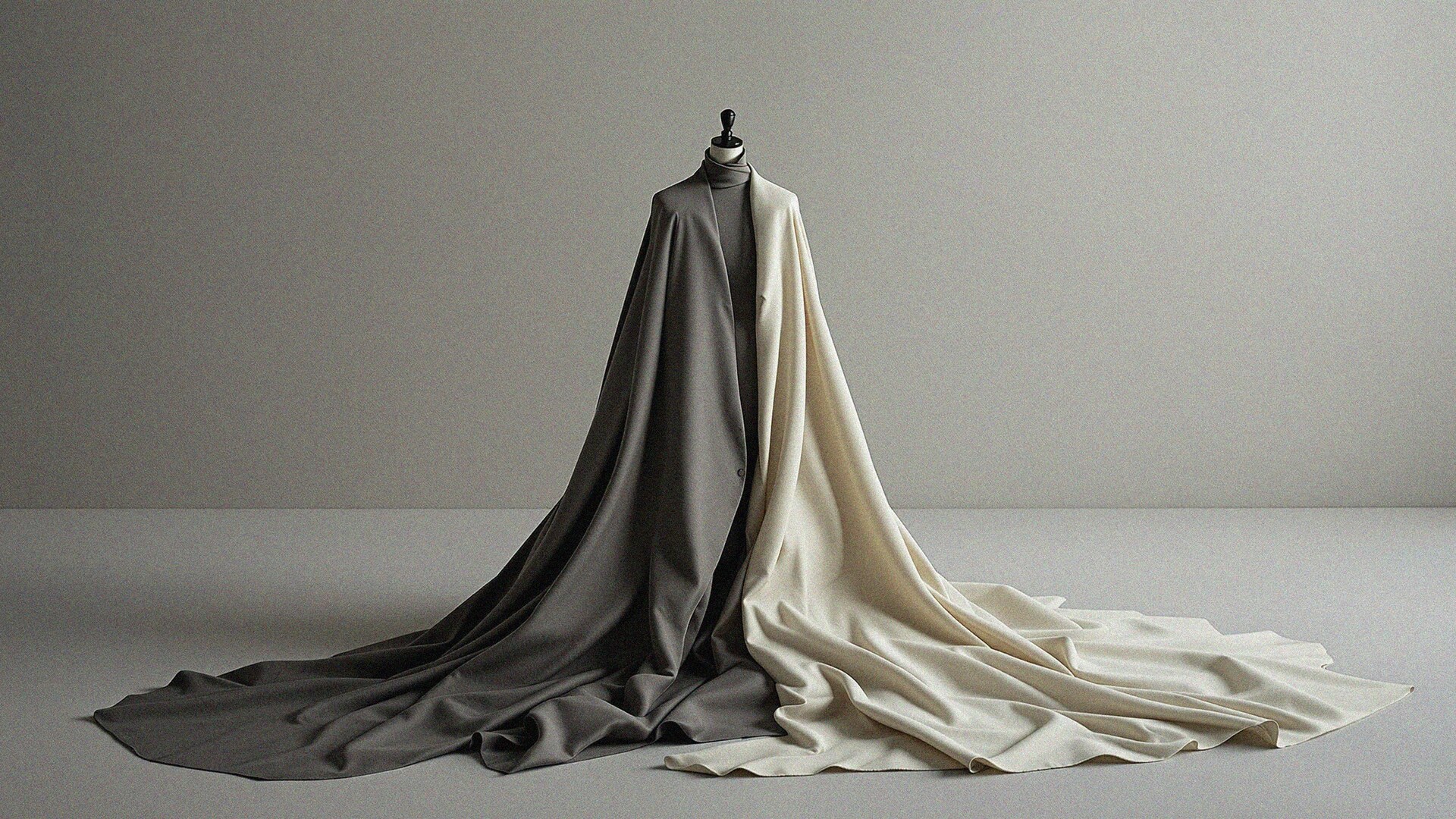
Nothing is wrong with either shirt. They simply behave differently — and the difference is not a mystery, or a matter of price. A garment moves the way it does for three knowable reasons: what it weighs, how it was cut, and how the cloth itself feels in the hand. Once those three become visible, a closet stops being a collection of similar-looking things that perform in confusingly different ways.
Weight: how a fabric falls
Drape is the word for how cloth responds to gravity — whether it folds in soft, deep waves or holds a crisp plane. The first thing that decides this is weight.
Fabric weight is usually measured in grams per square meter, and the number tracks closely with behavior. A featherweight voile, somewhere under 100 gsm, ripples at the smallest movement of air. A mid-weight poplin holds its collar up and its cuffs out. A heavy flannel or a dense wool coating barely folds at all; it bends in wide, architectural curves, more like paper than like water.
This is why two "identical" white shirts refuse to be identical. The lighter one collapses toward the body and shows every contour beneath it. The heavier one keeps its own geometry and skims past the body entirely. Neither is better. But they do different work, and reaching for one when the day calls for the other is the source of a lot of quiet dissatisfaction that gets misdiagnosed as "this shirt doesn't fit anymore."
Weight also explains why a garment can feel wrong in one season and right in another. The linen trousers that seemed limp and tired in November were never tired. They were built to move with warm air, and in July they do exactly that.
Bias: how a fabric was cut
Woven cloth has a grain — the direction of its threads. Warp threads run the length of the bolt, weft threads run across it, and along either of those directions a woven fabric barely stretches at all. Pull a cotton shirt straight down and it gives almost nothing.
Now pull the same shirt diagonally, corner to corner. It stretches. That diagonal is the bias, the 45-degree line across the grain, and along it even the most rigid weave becomes elastic.
Most garments are cut on the straight grain, threads running vertically, because it's stable and economical. But when a pattern piece is turned 45 degrees and cut on the bias, the finished garment behaves like a different material entirely. It clings without being tight. It swings when the body turns. It pools slightly at the hem instead of hanging in flat panels.
This is the secret of the 1930s evening dresses that seem to pour over the body — and of the humble details hiding in ordinary closets:
- A necktie is cut on the bias, which is why it knots smoothly and recovers its shape overnight on the rack.
- The curved neckline binding on a good T-shirt often runs on the bias so it can turn a corner without puckering.
- A bias-cut skirt in plain silk or viscose moves the way a straight-cut version of the same fabric never will.
Hand: how a fabric feels
Hand is the textile trade's word for the tactile character of cloth — what it communicates through the fingers before it's ever worn. Dry or waxy. Crisp or fluid. Cool or warm. Dense or airy.
Hand overlaps with drape but isn't the same thing. Two fabrics can weigh the same and fall quite differently because of how they're spun and finished. A tightly twisted wool crepe has a dry, springy hand and a lively drape; a wool flannel of equal weight is soft, brushed, and comparatively still. Silk shows the range most clearly: a crisp taffeta rustles and holds sculptural folds, while a charmeuse of similar weight slides through the fingers and clings to whatever it touches.
Finishing changes hand too, which is why garments evolve. Denim starts stiff and breaks in along the lines of one particular body. A linen shirt begins slightly crisp and, over a few dozen washes, softens into something closer to well-worn bedsheets. When people live with linen for a few years, they tend to stop calling this wear and start calling it the point.
Hand is also the most honest information available at the moment of buying — more honest than the label, which names the fiber but not the construction. "100% cotton" covers both a gauzy summer shirt and a canvas work jacket. The fingers already know the difference; the label doesn't.
Reading what's already on the rail
These three properties — weight, bias, hand — are why a wardrobe can be full and still feel unreadable. Garments that look alike on hangers behave unalike on bodies, and the ones that get worn constantly are usually the ones whose behavior matches their owner's actual days, whether or not anyone has articulated why.
Articulating why turns out to be useful. The much-worn sweater and the never-worn one often differ not in color or cut but in hand — one is dry and light, the other dense and warm, and only one of them suits the rooms its owner actually sits in. Seeing a whole closet at once, the way a tool like Vitrina lays it out, makes these patterns easier to notice: the heavy, structured things cluster in the worn column, or the fluid ones do, and a preference that was always operating silently becomes something that can be named.
Once named, it changes how everything on the rail gets read. The jacket that "never looked right" reveals itself as too light for the structure its cut promises. The dress that always works turns out to be the only bias-cut thing in the closet.
The fold at the elbow
There's a particular pleasure in watching someone handle a garment they understand — the way they pinch a sleeve to feel the twist of the yarn, or hold a skirt by the waistband to watch where the fabric wants to fall. Nothing is being evaluated. They're just reading, fluently, a language the cloth has been speaking all along.
Most closets are written in that language. Weight sets the rhythm, grain sets the direction, hand carries the tone. The garments have been saying, quite precisely, what they are and how they'll behave — through every wearing, every wash, every fold at the elbow. Learning to listen doesn't add a single thing to the wardrobe. It just makes the whole of it legible, which is its own kind of quiet.