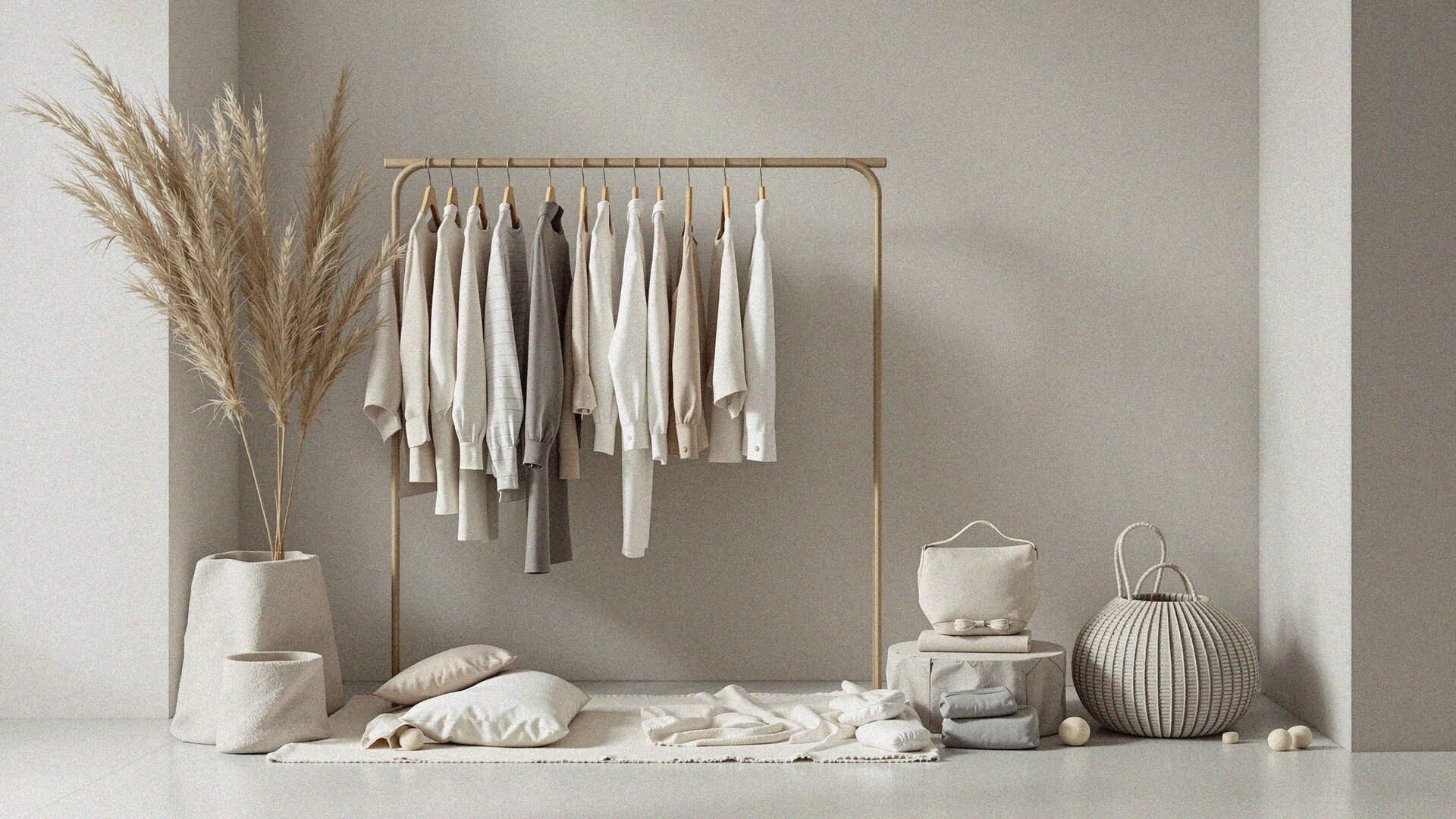
Most people have never heard their own closet make that sound. They've only known the other version — the one where everything is technically present and nothing is quite findable.
The morning it changes
You notice it first in the dressing. Not in some grand way. You just stop standing in front of the rail for that extra forty seconds, the ones that used to feel like nothing and actually weren't.
The shirt you want is where shirts are. You wore it Tuesday, it's clean, it's here. There's no archaeology involved — no lifting one thing to check what's behind it, no remembering you own something only to find it crushed at the back.
This is the part people don't expect. A half-empty closet doesn't feel like loss. It feels like the room exhaling.
What "half-empty" actually means
It rarely means you got rid of half your clothes. The number on the hangers might barely change.
What changes is the proportion of things you actually wear to things that are merely stored. A closet can be physically full and functionally half-empty — most of it dead weight you've trained your eye to skip over. The reverse is the quiet goal: fewer things present, nearly all of them in rotation.
When that shift happens, a few things tend to become true at once:
- The clothes have space around them. Fabric isn't compressed. A wool coat keeps its shoulder; a linen shirt doesn't come out with permanent fold-creases from being wedged.
- You can see in one glance. The whole of what you own is legible without digging. Nothing hides.
- Choosing stops being a negotiation. You're picking from things you like, not sorting past things you tolerate to reach them.
The drawer test
Open the drawer you use most. The one with the everyday things.
In a full wardrobe, that drawer is a compression. You pull a t-shirt and three others shift. You fold something back in and have to press the drawer shut.
In a half-empty one, the same drawer has slack. Things lie flat. You can see colour without unstacking. People who live this way for a while often report the same small surprise — they'd assumed the fullness was abundance, and it turned out to be friction.
Why the emptiness reads as calm and not as lack
There's a fear that sits underneath keeping too much: that if you let things go, you'll feel the gap. That the closet will look like something is missing.
In practice the opposite tends to happen. What you feel missing in a crowded closet is yourself — your actual taste, buried under the hedge-bets and the maybes and the things bought for a version of your life that didn't arrive.
When the maybes leave, what remains is unambiguously yours. A half-empty closet is mostly just a closet that has stopped arguing with you. Every item in it has already won its case.
The math underneath, quietly
There's a practical layer here too, and it deserves a mention without becoming the point.
When you wear the same well-chosen forty things across a season instead of rotating through a hundred half-liked ones, each piece earns its keep. The cost-per-wear of the things you love drops toward nothing, simply because you reach for them. The expensive mistakes reveal themselves as the things you never touch.
But that arithmetic is a consequence, not a motive. Nobody clears a closet and then feels lighter because they did a sum. The lightness comes first; the math just confirms it later, the way a receipt confirms a meal you already enjoyed.
Seeing the closet you already have
The strange obstacle to all of this is simple: most people cannot actually see their own wardrobe. It's spread across a rail, two drawers, a coat hook, the laundry, a suitcase from the last trip. The whole is never in front of you at once, so you shop and store as if you owned less than you do.
Laying it all out — even just once, even as a set of photographs — tends to be the moment the fog lifts. This is the quiet thing Vitrina is for: a way to look at everything you own in one view, so the closet stops being a place you rummage and becomes a place you actually know. The half-empty feeling often starts there, not with a single thing thrown away, but with finally seeing what was there the whole time.
After that, the editing barely feels like editing. You're not deciding what to discard. You're noticing what you already never wear, and letting it become obvious.
What stays
The things that survive this attention have a pattern, once you look.
They tend to be the items that fit the body you currently have, not a future or past one. The colours that show up in photographs of you looking like yourself. The textures your hand goes to without deciding — the cotton that's gone soft, the jacket with the collar that's learned your neck.
None of these are the clothes you'd photograph for anyone else. They're the ones that disappear when you wear them, which is the highest thing clothing can do.
The part nobody warns you about
A half-empty closet can be briefly unsettling, because the noise was doing a job. The abundance was a kind of reassurance — proof, however false, that you were prepared for anything.
Then a week passes, and you realise you got dressed every day without strain, and nothing was missing. The preparedness was a story. What you needed was always a small, knowable set of things, and now you can see it.
That's the real texture of a half-empty closet. Not minimalism, not discipline, not a project you completed. Just the ordinary quiet of opening a door in the morning and knowing, without looking hard, exactly what is yours.