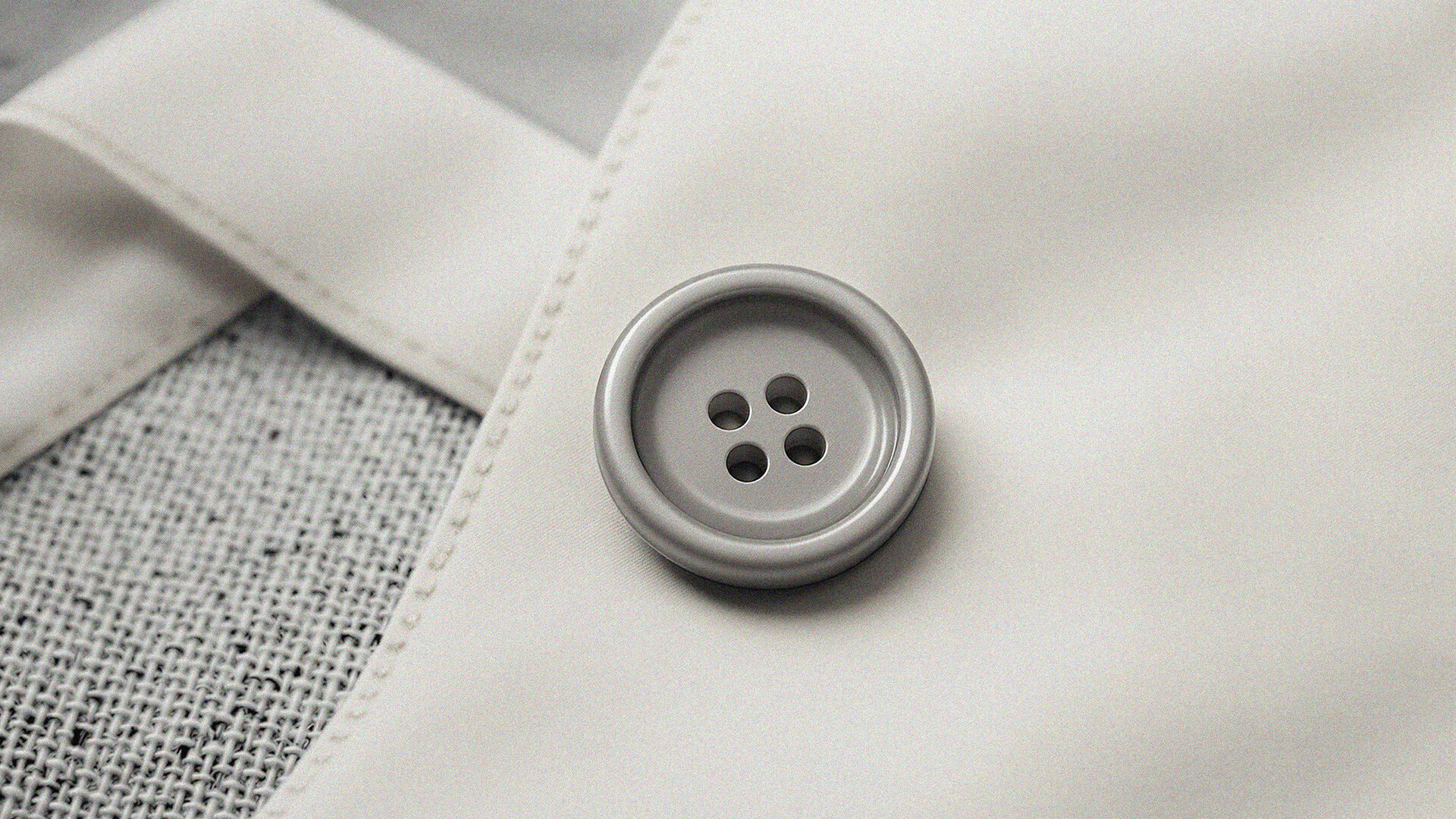
Most people rarely look at a buttonhole closely. But a buttonhole records more about how a garment was made than almost any other detail. It is where fabric gets cut on purpose, and where the maker had to choose how much time that cut was worth.
A cut that has to hold
Every buttonhole begins as a wound in the cloth. A slit goes through woven or knitted fabric, and something has to stop it from unravelling. Everything else follows from that problem: the stitch, the shape, the orientation, the order of work.
There are broadly two ways to solve it. A machine can stitch a dense rectangle of zigzag thread, and a blade then opens the fabric between the rows. A person can cut the fabric first and then wrap the raw edge by hand, one knotted stitch at a time. Either can be done well. Their results look different, and they wear differently over the years.
The machine buttonhole
On most shirts, trousers and knitwear, the buttonhole is machine-made, and it is often perfectly good. When people examine a well-made shirt closely, they tend to notice a few things:
- The stitches are tight and even, with no fabric visible between them.
- The cut edge sits cleanly inside the stitching, with no whiskers of thread poking through.
- The back looks almost identical to the front.
The hand-sewn buttonhole
A hand-sewn buttonhole is cut first. The tailor then lays a length of firm cord, called gimp, along the edge and works over it with silk or cotton thread in a buttonhole stitch. Each stitch forms a tiny knot, called a purl, at the lip of the opening.
The result is raised and slightly sculptural. Up close, the stitches show a faint irregularity that machines don't produce, because each one was pulled by hand. The back is flatter and rougher than the front. That difference is a reliable clue, since a machine buttonhole looks the same on both sides.
On a tailored jacket, the most visible example is often the lapel buttonhole. Some Italian workshops make a dense, ridged version known as a Milanese buttonhole, and it can take a skilled finisher the better part of an hour. Nobody needs it, since the lapel buttonhole is rarely buttoned at all. Its existence says something about the workshop's priorities.
What the shape tells you
Buttonholes are not all straight slits. Their shape follows the button they are meant to receive.
The keyhole
Coats, jackets and jeans often carry a keyhole buttonhole, a straight slot with a small round eyelet at one end. The eyelet makes room for the button's shank, the short stem of thread or metal between the button and the cloth. Without that room, a thick wool coat would strain against its own closure. On jeans, the keyhole receives a hammered metal button. On a tailored overcoat, it receives horn or corozo sewn with a thread shank.
The straight slit
Shirts use plain straight buttonholes, because shirt buttons are flat and the fabric is thin. A shank would be pointless there. A keyhole on a dress shirt would look heavy, the way a winter boot would look heavy with a linen suit.
The bound buttonhole
Some coats and finer dresses have bound buttonholes. Here the opening is framed with small lips of fabric rather than thread, like a miniature welt pocket. They are slow to make and difficult to repair. They are now uncommon, and they turn up mostly on older pieces or couture work. When one appears on a vintage coat, it usually means someone took the time to make the whole coat properly.
Why they run the way they do
The direction of a buttonhole is never arbitrary. On a coat, buttonholes run horizontally because the strain on a closed front pulls sideways. Under that pull, the button slides to the outer end of the opening and stays there instead of slipping free.
On a shirt placket, buttonholes run vertically. The placket is a narrow strip, and a vertical opening keeps the buttons in a straight line down the chest. The collar band and the cuffs, which take sideways tension, usually have horizontal buttonholes. On some shirts the lowest buttonhole is horizontal too, because it sits where the shirt is tucked in and pulled.
Sleeve buttons on a jacket tell their own small story. Many jackets have decorative buttons stitched over buttonholes that were never cut. When the buttonholes actually open, a detail called working cuffs or surgeon's cuffs, the sleeve length was usually set to fit before the holes were cut. Once that cut is made, the sleeve can no longer be shortened from the cuff.
Reading the clothes you already own
Almost nobody chooses a coat for its buttonholes. But once people start noticing them, buttonholes become a way of reading a garment they have owned for years. A shirt can have perfect stitching on the buttonholes and loose stitching along the hem. A blazer can have fine hand-sewn buttonholes on the lapel and machine-made ones on the sleeves, which shows exactly where the maker drew the line.
Some people keep a photo record of what they own, in Vitrina or simply in a camera roll. Close-up details like these often end up in the frame by accident. Seen next to each other, they show patterns that are invisible when each piece hangs on its own hanger. The coats that lasted tend to share a quality of finish. So do the ones that didn't.
The cost logic is real, though it is quieter than people expect. A densely stitched buttonhole adds very little to the price of a garment, and it is often the reason a shirt survives three hundred washes instead of eighty. The difference shows up in years of wear rather than in money saved.
Care at the opening
A buttonhole that has started to fray can usually be saved. A tailor can overstitch a machine buttonhole or rework a hand-sewn one with fresh thread. On a good coat, this is a small, inexpensive repair. People who wear the same coat for a decade often have each buttonhole reworked at least once, and they tend to remember when.
Strain also matters. Buttoning a coat with one hand, while carrying a bag in the other, pulls the opening off its line. People who have lived with good wool for years tend to slow down at this point. They push the button through with the thumb rather than drag the fabric over it.
The smallest signature
A buttonhole is roughly two centimetres of thread, and for most of a garment's life no one looks at it. But it holds the whole question of how something was made: whether the cut came first or last, whether the edge was wrapped by hand, and whether anyone expected the coat to be worn this long.
The navy coat has gone to a tailor, who will rework the softened end. When it comes back, the repair will be slightly visible to its owner and to no one else.