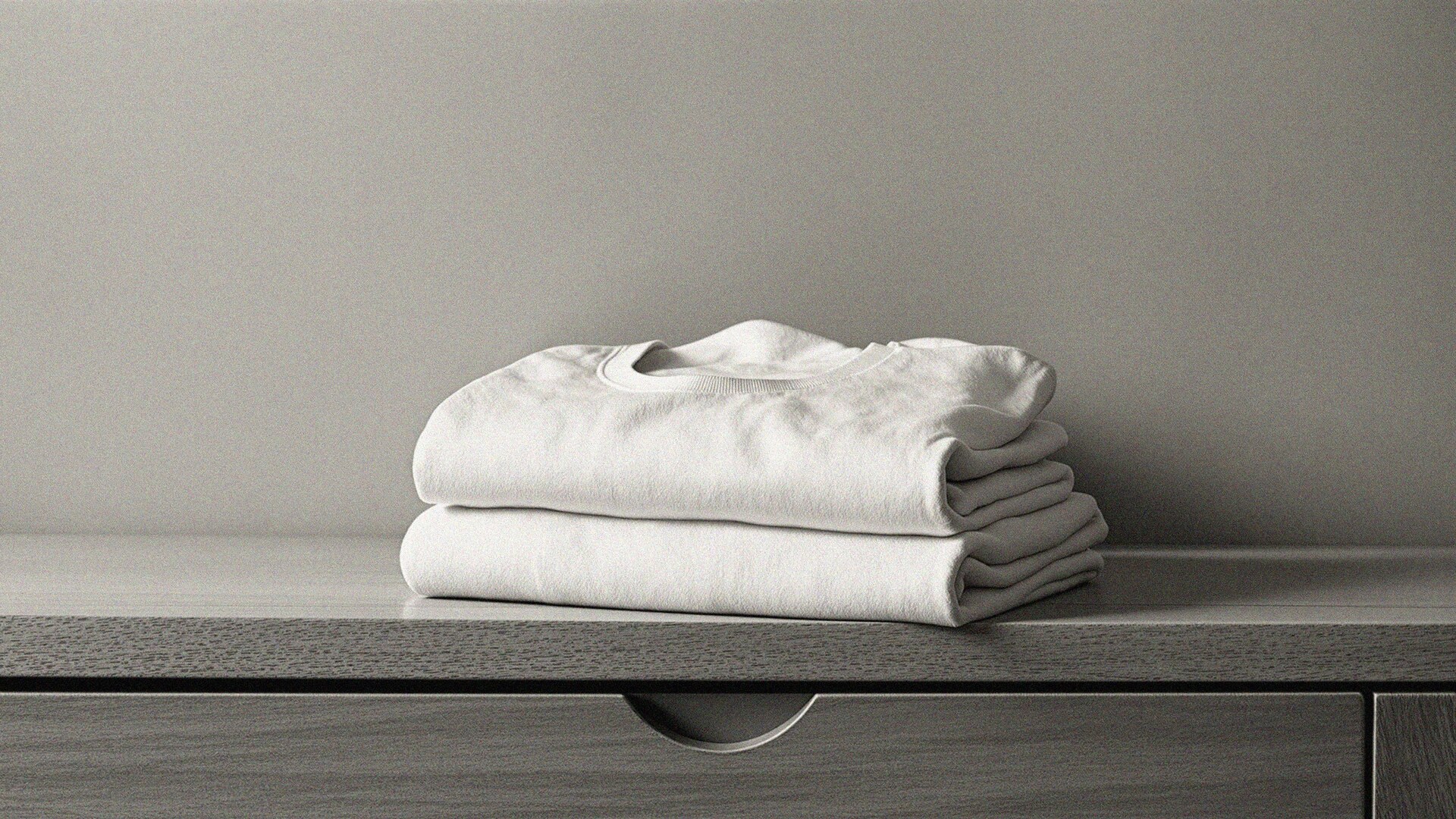
It might be soft cotton gone slightly thin at the collar. It might be the linen one that wrinkles no matter what and somehow looks right anyway. Whatever it is, it has stopped being a choice and become a habit your body made on its own.
Most of us own thirty shirts and wear four. This one is usually in the four.
Why the Hand Knows Before the Mind
The shirt you reach for without looking has passed a test the others haven't — and the test wasn't about how it looks on a hanger.
It fits the actual shape of your day. It doesn't pinch when you sit, doesn't ride up when you lift your arms, doesn't need a particular bra or a particular jacket to make sense. The collar sits where you forget about it. The sleeves end where you stopped noticing them.
Comfort that disappears is the real luxury here. A garment you have to manage all day — adjusting, tugging, staying aware of — never becomes the one you reach for. The body keeps a quiet ledger of which clothes ask for attention and which ones give it back.
When people pay attention to this pattern, they usually find the same thing: the reached-for shirt was never the most expensive or the most flattering. It was the one that asked for nothing.
The role of the unremarkable
There's a reason this shirt is often plain. Loud pieces announce themselves; you have to be in the mood for them. A white shirt, a faded navy, an oatmeal henley — these don't require you to feel a certain way before you can wear them.
They become the floor your other clothes stand on. The interesting jacket needs the unremarkable shirt underneath to feel like an outfit rather than a costume.
The pieces that do the most work are rarely the ones that get noticed.
What This One Shirt Teaches About the Other Twenty-Nine
Here is the quiet thing worth sitting with: you already know what works. You proved it this morning, with your eyes still half-closed.
The shirt you reach for is a finished answer to a question the rest of your closet is still asking. It holds, in physical form, your real preferences — the weight of fabric your hands trust, the neckline that suits your face, the cut that matches how you actually move.
The other shirts aren't failures, exactly. Some are aspirational. Some were bought for a version of your life that didn't arrive. Some fit a room you're rarely in. They sit there as evidence of guesses, while the reached-for shirt sits there as evidence of knowledge.
When you start to see the closet this way — not as a collection but as a record of what you've already learned — the whole thing gets quieter. There's a tool called Vitrina that simply lays out what you own, and the strange effect of seeing it all in one place is that the four you actually wear stop hiding among the thirty you don't.
The math, briefly
It's worth noting, somewhere in the middle and not at the front, that the reached-for shirt is almost always your cheapest garment per wear. Worn weekly for three years, even a modest shirt costs pennies each time you put it on.
The forty-dollar shirt you love beats the two-hundred-dollar one you admire. This isn't an argument for buying cheap — it's an observation about what use does to value. Wear is the only thing that earns a garment its keep.
But this is reassurance, not the point. The point is that you already chose well, repeatedly, without thinking of it as choosing.
Living With the One You Reach For
People who notice their reached-for shirt tend to start treating it differently. Not as a workhorse to be used up, but as something worth keeping in the rotation a while longer.
When you live with one shirt for years, a few things tend to happen:
- You learn how it washes — that it prefers cold water and a flat dry, that the dryer ages it faster than the wearing does.
- You catch the loose button before it leaves, because you'd notice its absence the way you'd notice a missing key.
- You stop comparing it to newer things, because newness was never what made it good.
- You let it earn its softness, its fade, the small marks that turn a shirt into yours specifically.
When one becomes a pattern
The interesting move isn't to protect your one reached-for shirt. It's to ask why it works, and to let that answer shape what you keep.
If it's the weight of the cotton, you now know something true about yourself. If it's the way the collar sits open, that's information. The reached-for shirt is a small, honest survey of your own taste, and most people have never read the results.
Slowly, a closet can drift toward more of what gets reached for and less of what gets skipped. Not as a purge or a project — just as the natural outcome of paying attention to which clothes your hands already trust.
The Morning Test
Tomorrow, watch your own hand. Notice what it reaches for before your mind weighs in.
That reflex is years of quiet data — every shirt that pinched, itched, wrinkled wrong, or sat unworn taught your body something. The reach is the conclusion.
A closet full of clothes you'd reach for without looking isn't a fantasy of abundance. It's the opposite: a small number of right answers, each one known so well it no longer needs deciding. The quiet of that — getting dressed without negotiation — is worth more than any shirt in it.