The Selvedge Edge, Explained: What Those White Stripes Mean
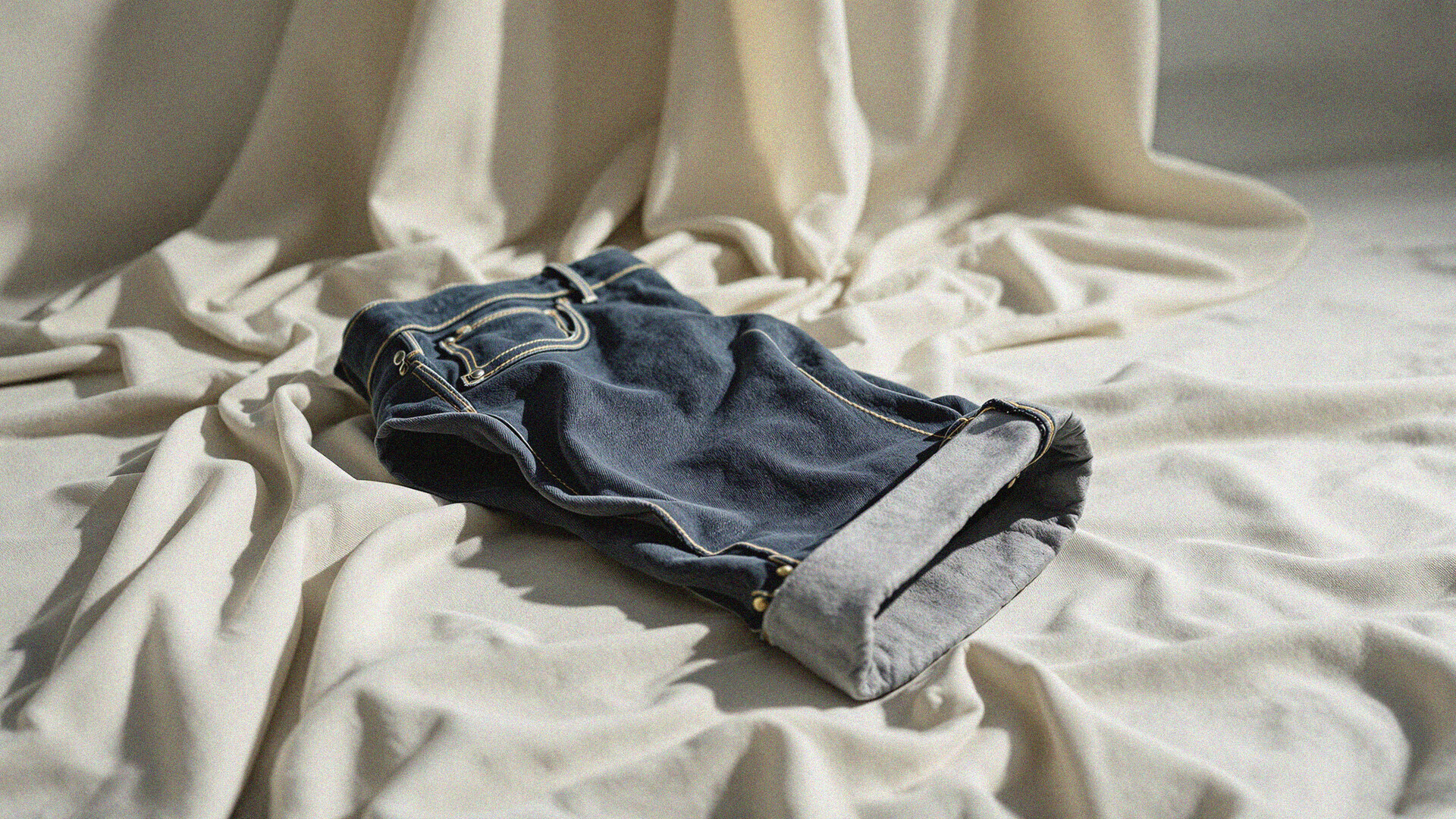
A pair of jeans on a chair, cuffed once at the ankle. Along the inside of the fold there is a narrow white band, sometimes with a thin red thread running through it. Most people who own such a pair noticed it in the shop, decided it looked nice, and never asked what it was.
It is not decoration. It is the edge of the cloth, exactly as it came off the loom.
What the word actually means
Selvedge is a contraction of "self-edge." Every woven fabric has two long edges, and on a certain kind of loom those edges finish themselves. The weft thread travels across the warp, reaches the end, turns around, and comes back. Nothing is cut. The result is a tight, clean border that will not fray.
That is the whole secret. The white stripe on a cuff is the outer margin of a bolt of denim, left intact and turned into the outseam of the leg. The red thread, where there is one, was originally a mill's way of identifying its own cloth. Cone Mills in North Carolina used red. Other mills chose green, yellow, or blue, and some still do.
Why it takes a particular loom
The loom that makes selvedge is the shuttle loom. A small boat-shaped shuttle carries the weft thread back and forth, and because it is one continuous thread, the edge closes on itself with every pass. Shuttle looms are slow. They are also narrow, and the bolts they produce are roughly half the width of modern denim.
In the middle of the last century most mills replaced them with projectile looms. Those fire the weft across in short lengths and cut it, so the edges of the fabric come out raw and have to be overlocked or hidden inside a seam. The cloth is wider, the process is faster, and the cost per yard drops. That is the denim in nearly every pair of jeans made today.
Some of the old shuttle looms survived. A good number ended up in Japan, where mills in Okayama kept them running and became known for it. A few American mills held on too. When a pair of jeans shows a selvedge line at the cuff, it means the fabric came from one of those looms.
What it changes in the garment
Because the bolt is narrow, a pattern maker lays the leg pieces so the finished edge falls along the outseam. That is why the stripe shows only at the outside of the leg, and only when the hem is turned up. On an uncuffed pair it is invisible.
A few things follow from this:
- The outseam is a single clean edge rather than a folded and serged one, so it lies flatter against the leg.
- The fabric tends to be denser and slightly uneven, since shuttle looms put less tension on the yarn. The surface has more texture, sometimes a faint slubbiness that catches light.
- The narrow width means more waste in cutting and more time on the loom, which is where the higher price comes from. The number on the tag is a record of hours, not of a logo.
Selvedge and raw are not the same word
The two get used interchangeably and they should not be. Raw denim is fabric that has not been washed or treated after dyeing. Selvedge describes how the edge was woven. A pair can be raw and selvedge, raw and non-selvedge, or selvedge and pre-washed. Plenty of well-made jeans are selvedge but arrive soft and already faded.
Where the two overlap, on a raw selvedge pair, the fabric starts stiff and dark and takes on the shape of whoever wears it. The creases behind the knee, the lighter bands at the thigh, the pale streaks along the outseam that denim people call train tracks: those are a slow print of one person's habits. They come from walking, sitting, and carrying things in the same pocket for a year.
Living with a pair
People who have kept a pair of selvedge jeans for several years tend to talk about them the way they talk about a well-used kitchen knife. They know the fit at the waist after a wash, and how long it takes to relax again. They know which cuff height suits which shoes. They wash rarely, because washing resets some of the shape, and when they do wash, they turn the pair inside out and use cold water and let it dry flat.
Repairs happen at the crotch and the back pocket, usually after two or three years. A tailor darns the thinning area with matching thread and the pair goes back into rotation. This is not thrift for its own sake. It is the natural response to a garment that has become specific to you.
Some people find it useful to see where a pair like this sits among everything else they own. When a wardrobe is photographed and laid out in Vitrina, a single dark pair of jeans that goes with most of the shirts on the rail tends to become obvious in a way that it never is from inside the closet. What they wear with it, and how often, becomes visible rather than assumed.
Reading the stripe
Once someone knows what the white line is, they start noticing it elsewhere. On a chambray shirt, where the selvedge sometimes appears on a placket or a cuff. On a length of Japanese cotton at a fabric shop, still on the bolt, both edges showing. On a friend's jeans at a table, turned up twice.
It is a small piece of evidence about how something was made. A shuttle, a thread turning back on itself, a mill that kept the old machines running. That a garment can carry its own origin in its seam, quietly, and that a person can learn to read it, seems like reason enough to have asked.