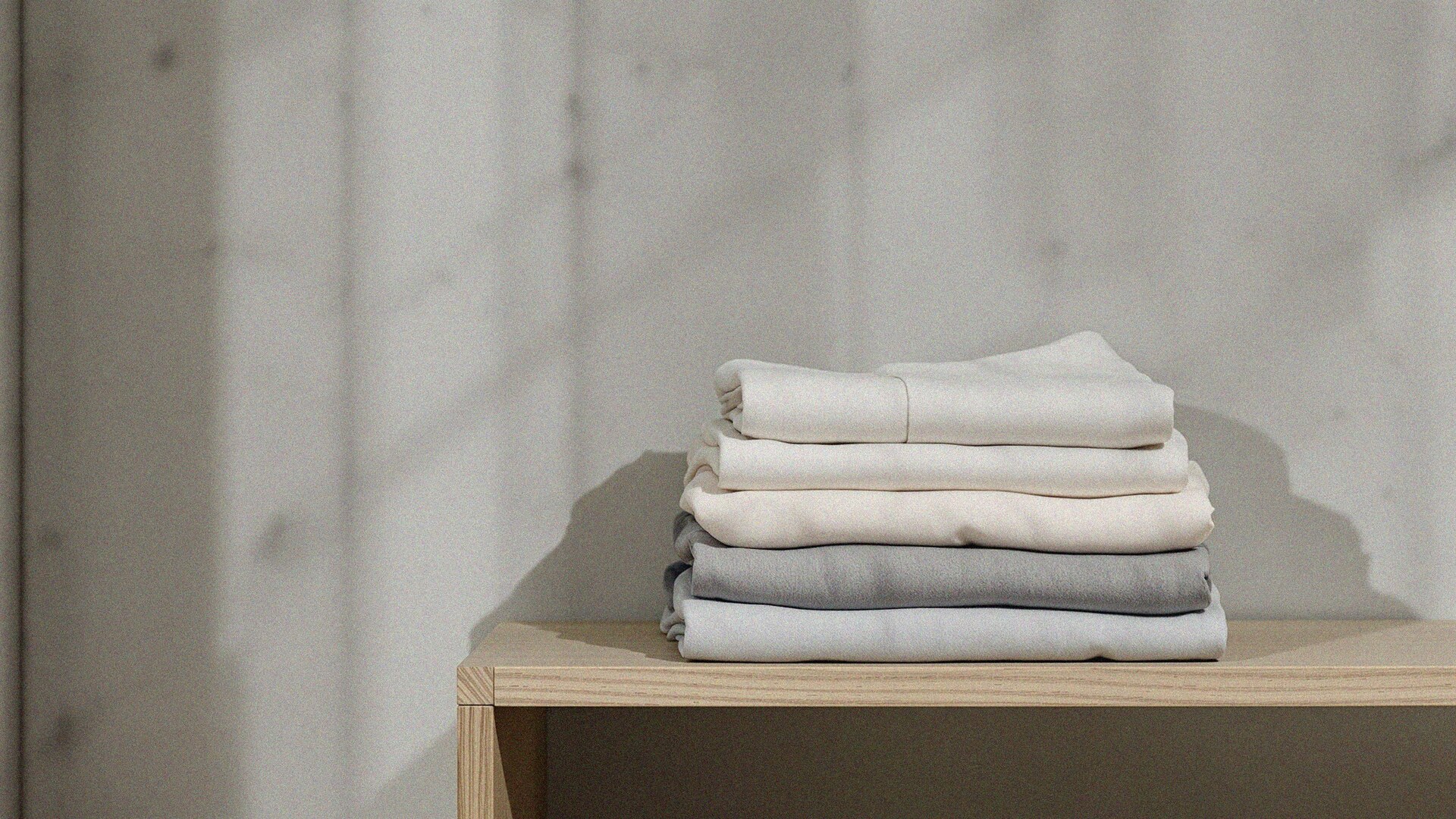
And yet most mornings you reach for the same three.
The gap between owning and rotating
A rotation audit starts from one honest question. Of everything you own in a single category, how much of it actually moves?
Not how much you like. Not how much you paid. What leaves the drawer, touches your body, comes back to the wash. The rotation is the small, loyal subset of a category that does the real work of your week — and it is almost always far smaller than the category itself.
People discover they own fourteen white shirts and wear four. Eleven pairs of jeans, three in rotation. The other eight aren't bad jeans. They're just not the jeans, and some quiet arithmetic in the body decided that months ago without telling anyone.
The audit is the act of finally listening to that arithmetic.
Why the pile grew
Overcollection in one category is rarely random. It follows a pattern, and the pattern is usually a version of the same near-miss.
- The replacement that didn't replace. You bought a better white tee, but the old one never left. Now you have two, and neither is fully retired.
- The almost-right. The linen shirt is the correct blue but cut a touch boxy, so you keep buying its cousins hoping one lands. They accumulate. None of them is the one.
- The safe purchase. Unsure what a trip or a season needs, you buy the thing you already understand. Another gray crewneck. It's never wrong, which is exactly why it never gets worn instead of the crewneck you already trusted.
Doing the audit
The point of a rotation audit isn't to purge. Purging is a mood, and moods pass. The point is to make the category visible enough that decisions become obvious rather than agonized.
Pull the whole category into one place. Every white shirt, on the bed, at once. The visual shock of the count does most of the work — you cannot un-see fourteen of a thing once they're laid out in a row.
Then sort by how they actually behave:
- The rotation — worn in the last month or two, no hesitation, reach without thinking.
- The bench — good, occasionally chosen, would be missed if gone. A real second string.
- The dormant — untouched for a season or more, kept for reasons you'll want to name out loud.
What the numbers quietly tell you
Here's where a little math earns its place — not as the reason to audit, but as reassurance once you're in it.
If you own fourteen white shirts and four carry your month, the cost of the shirt you love isn't its price tag. It's its price divided by every wear it will honestly get, and the shirts you reach for keep dividing that number down toward nothing. The four in rotation are, in the plainest sense, the cheapest things you own — you just bought them a while ago and stopped noticing.
The dormant ten are the expensive ones. Not because they cost more, but because their cost never got spread across use. A forty-dollar shirt worn twice is a twenty-dollar-a-wear shirt. The one you've worn ninety times has quietly become almost free.
This isn't an argument for owning less as a virtue. It's just what the drawer already knows. Seeing the split written down tends to loosen the grip on the pile — not through guilt, but through recognition.
The category that's actually thin
The strange gift of a rotation audit is what it reveals in the other direction.
When you finally see that your seven black tees do the job of maybe two, you also start to notice the gap they were hiding. All that redundancy in one corner usually means scarcity in another. Fourteen white shirts and not one thing warm enough for a cold, formal night. Six pairs of sneakers and nothing you'd wear when it actually rains.
Balance isn't just trimming the fat category. It's letting the audit point at the honest hole — the thing you keep improvising around because the surplus elsewhere made the closet feel full.
This is often where a tool like Vitrina does its quiet work: seeing the whole of a category at once, wear counts and all, so the fourteen-versus-four truth is simply visible instead of something you have to lay out on the bed to believe.
Living with the rotation
After the audit, the dormant pile doesn't have to vanish overnight. Some of it will move back into rotation now that you've seen it and remembered why you liked it. Some will go, gently, to someone who'll actually wear it. Some earns its keep for one specific occasion a year, and that's a fair reason to stay.
What changes is the buying. Once you know your rotation runs on four shirts, the fifteenth white shirt stops being a temptation and starts being a fairly silly idea. Not through discipline. Through arithmetic you can finally feel.
The next time you stand in that shop holding the almost-right blue, you'll have the whole category behind your eyes — the row on the bed, the four that get worn, the ten that didn't. And you'll put it back, not out of restraint, but because you already know how the story of the eleventh one ends.
The wardrobe that fits is rarely the one with the most in it. It's the one where the drawer you open and the things you reach for have quietly become the same drawer.