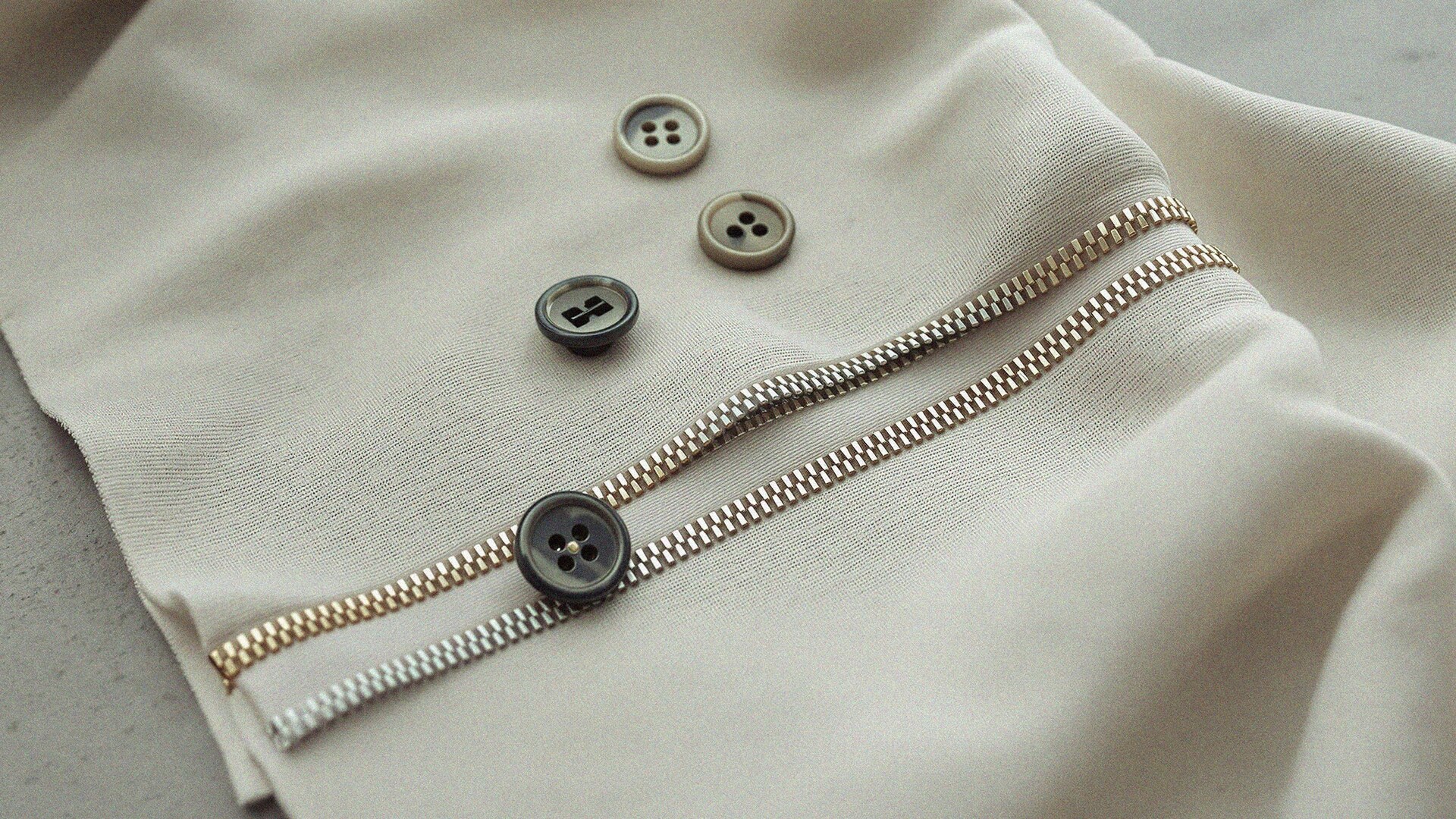
Hardware is the part of a garment nobody looks at and everybody depends on. A coat is only as good as the thing that closes it. And once you start noticing zippers, snaps, and buttons — really noticing them — you start reading your whole wardrobe differently.
The quietest quality signal there is
Fabric gets all the attention. Wool weight, cotton weave, whether the linen was European. But fabric rarely ends a garment's life. Hardware does. The trench coat with the cracked buckle, the jeans with the button that pulled through, the dress with the invisible zipper that stopped being invisible and started being stuck.
Makers know this, which is why hardware is one of the most honest places to judge a garment. Fabric can be made to feel expensive for a season. A zipper either works in year five or it doesn't, and the manufacturer decided which one you got before you ever saw the coat.
The names are worth knowing, not as trivia but as a way of seeing. YKK, the Japanese company that makes roughly half the world's zippers, is the reliable baseline — when a brand cheaps out below YKK, it says something. Riri and Lampo, the Swiss and Italian houses, are what you find on outerwear built to outlive its owner. The name is stamped on the slider, small enough that you've probably never read it. It's there on almost everything you own.
Reading a zipper
A zipper has three parts that matter: the teeth, the slider, and the tape they're stitched to. Each one tells you something.
- Metal teeth — brass, nickel, aluminum — sit in heavy garments like jeans and leather jackets, where they can take decades of strain.
- Molded plastic teeth, the chunky kind on fleeces and parkas, handle cold well and forgive being stepped on.
- Coil zippers, the fine continuous spiral on dresses and bags, run smoothest but depend entirely on the quality of the coil — the cheap ones are the ones that split open behind the slider.
People who've lived with the same field jacket for a decade tend to know this without thinking about it. They also tend to run a candle stub or a bit of beeswax along a stiff zipper once a year — not as maintenance, exactly. More the way you'd oil a hinge on a door you like walking through.
Buttons, and what they're made of
A shirt button, turned over, gives itself away. A faint seam line around the edge means molded plastic. A surface with depth — a slight variation in color, a grain — usually means one of the older materials, and a shirt that's probably better than you remembered.
Corozo, sometimes called vegetable ivory, comes from the tagua nut and shows a fine marbled grain up close. It takes dye beautifully and gets smoother with washing rather than duller. Mother-of-pearl is the shirt-maker's classic — cool to the touch in a way plastic never is, with that shifting light you notice mostly when you finally look. Horn buttons, on blazers and heavier coats, have visible striations and a warmth plastic imitates but can't hold.
None of this is about status. A corozo button costs the manufacturer cents more than a plastic one. What it signals is that someone in the production chain was paying attention to a part most buyers never examine — and attention at that level rarely stops at the buttons.
The other thing worth noticing is the shank — how the button attaches. Coat buttons sewn flat against the fabric with no thread shank underneath will strain and pop; buttons with a small stem of thread, or a built-in loop on the back, move with the fabric instead of fighting it. When a good coat sheds a button, it's usually the attachment that failed, not the button. Rescuing it takes a needle, five minutes, and the button itself, which is why the spare in the little envelope earns its place somewhere findable.
The snap's honest click
Snaps are binary in a way buttons aren't. A button can be halfway worn and still work. A snap either closes with a definite click or it mushes shut and slides open across a bag strap sometime in month eight.
The good ones — the ring snaps on Western shirts, the heavy gunmetal closures on chore coats — are four-part mechanisms set into the fabric with real force. The weak point is almost never the metal; it's the fabric around it. A snap set into a single layer of thin cotton will eventually tear free, taking a coin of fabric with it. Set into a reinforced placket, it can outlast the garment. That's visible before buying, and it's visible right now, in your own closet, on the jacket whose snaps still bite and the one whose snaps gave up.
This is the kind of detail that surfaces when you actually catalog what you own. People who use Vitrina to photograph their wardrobe often report a version of the same discovery: the garments they reach for most are, almost without exception, the ones whose hardware still works perfectly. The relationship runs both ways — things that close properly get worn, and things that get worn were usually built to close properly.
Repair as the second half of ownership
A replaced slider. A rescued button moved from the cuff to the collar. A snap reset by a tailor with the right press. None of this is thrift, exactly, though the math quietly works — a slider replacement costs less than a coffee and saves a coat.
It's closer to fluency. Knowing that the zipper isn't broken, just the slider. Knowing the button on your good coat is horn and worth re-sewing properly. The hardware on a garment is a set of small machines, and small machines respond to being understood.
The jacket with the twenty-year-old zipper still makes that sound — the slider seating, the teeth taking hold. Somewhere in your closet there's probably a garment like that, one whose hardware has never once made you think about it. That silence is the whole point. It's what lasting actually sounds like.