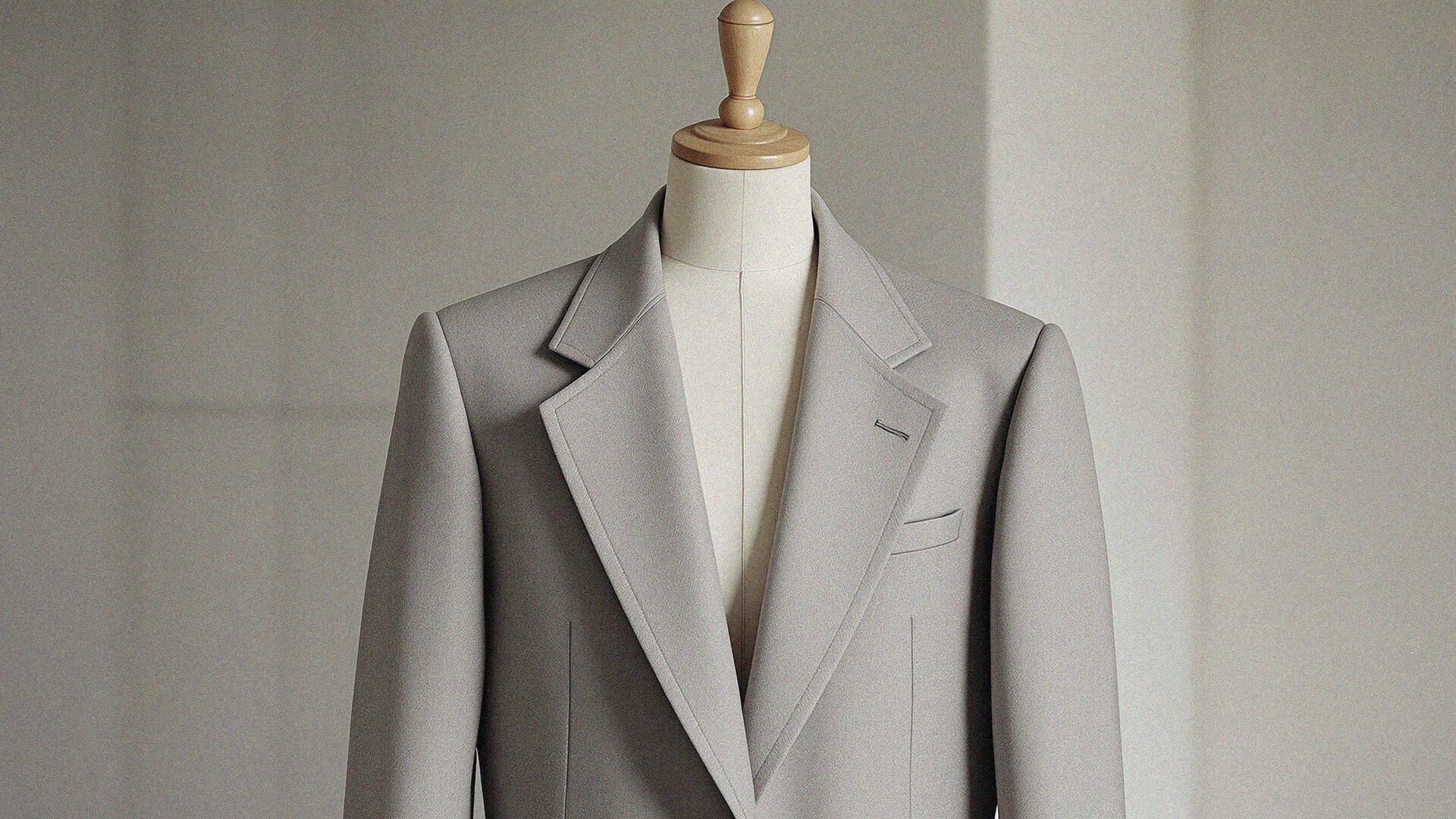
Most people who own tailoring have never looked closely at that seam. But it explains more about why a jacket gets worn, or doesn't, than the label inside it.
The line that decides everything
A jacket is architecture for the upper body, and the shoulder is its foundation. Everything below it — how the chest drapes, where the lapel rolls, whether the sleeve hangs clean or breaks into ripples — follows from what happens at that seam.
Tailors talk about the shoulder the way carpenters talk about a doorframe. Get it right and nothing else needs to fight for attention. Get it wrong and no amount of taking in the waist will save the garment.
Broadly, there are two schools: the structured shoulder and the soft shoulder. Neither is better. They are two different answers to the same question — how much should a jacket impose on the body, and how much should it yield to it?
The structured shoulder
A structured shoulder is built. Inside the seam sits a shaped pad, sometimes several layers of felt and wadding, and above it a strip called the sleevehead roll that lifts the top of the sleeve into a smooth arc. In the most formal version — the roped shoulder you see on Savile Row and in old photographs of diplomats — the sleevehead rises slightly above the shoulder line, like a low wall.
The lineage is military. British tailoring grew out of uniforms, and a uniform is meant to make every body read as capable: shoulders squared, chest lifted, a clean vertical drop. A structured jacket does the same quiet work. Someone with sloping or narrow shoulders puts one on and the silhouette corrects itself.
There is a particular feeling to wearing it. The jacket meets you before you move — you sense its perimeter, the way you sense the edges of a good chair. Some people find this reassuring, a kind of posture on loan. In a boardroom, at a funeral, at a wedding where photographs will outlive everyone's memory of the day, that borrowed formality is exactly the point.
The cost is ease. A structured shoulder is at its best standing still or walking slowly. Reach across a table and the whole upper back moves with the arm; the collar can lift off the neck. It is clothing for occasions with a shape to them.
The soft shoulder
The soft shoulder takes the opposite bet. Little or no padding, a sleevehead that is thin or absent, sometimes nothing between the wool and the body but a strip of canvas. The most extreme version is the Neapolitan spalla camicia — literally "shirt shoulder" — where the sleeve is attached the way a shirtsleeve is, with the seam pressed toward the body and small ripples of fabric, called shirring, gathered at the top.
Those ripples startle people who learned tailoring from department stores. They look like a flaw. They are the signature. Naples is hot, and Neapolitan tailors spent a century removing everything from the English jacket that a man sweating through August didn't need. What remained was a jacket that weighs about as much as a heavy shirt and moves like one.
A soft shoulder follows the body rather than framing it. Slope, and the jacket slopes with you. Reach, and the sleeve gives. On someone with strong natural shoulders it looks almost inevitable — as if the jacket were an opinion they'd always held. On someone hoping the jacket would supply shoulders, it declines the job.
The American natural shoulder — the Ivy sack coat, lightly padded, unroped — sits between the two schools, which is partly why it survived every swing of fashion for seventy years.
Reading the seam
The construction announces itself if you know where the differences live:
- A structured shoulder ends in a defined edge; the line from collar to sleeve is drawn, not found. On the hanger, the jacket keeps a body inside it.
- A roped sleevehead shows as a slight ridge where the sleeve begins — the sleeve looks set into the shoulder rather than flowing from it.
- A soft shoulder has no edge to speak of; the wool rounds over the joint and drops. Pinching the seam, there's little between your fingers but cloth.
- Shirring — those fine gathers at the sleevehead — means a shirt-style shoulder, the softest construction there is.
The shoulder you actually live in
Here is where the anatomy becomes personal. Most closets with any tailoring in them contain both constructions, bought in different years, for different imagined lives — and the wear patterns are rarely even. There is usually one jacket that goes everywhere and two or three that come out only under obligation.
The dividing line is almost always the shoulder. People who spend their days moving — teaching, cooking, hauling a bag across a city — drift toward soft construction without ever naming why. The structured jacket stays home not because it's wrong but because it asks for a stillness their days don't have. Laying the whole rail out at once, the way an app like Vitrina lets you see everything you own in one view, tends to make the pattern obvious: the jackets getting worn share a shoulder, and the ones going untouched share the other.
That recognition changes how the untouched ones read. The roped-shoulder suit isn't a failure of judgment; it's occasion clothing, and it can wait for occasions with a clear conscience. The unworn soft blazer bought for a holiday that never happened might simply belong to a different climate than the life it lives in.
There's a quiet fluency in knowing which shoulder is yours. It shows up on ordinary mornings — reaching past a jacket without guilt, reaching for another without deliberation, because you understand what each one was built to do. The seam was telling you all along. It just took looking at it.