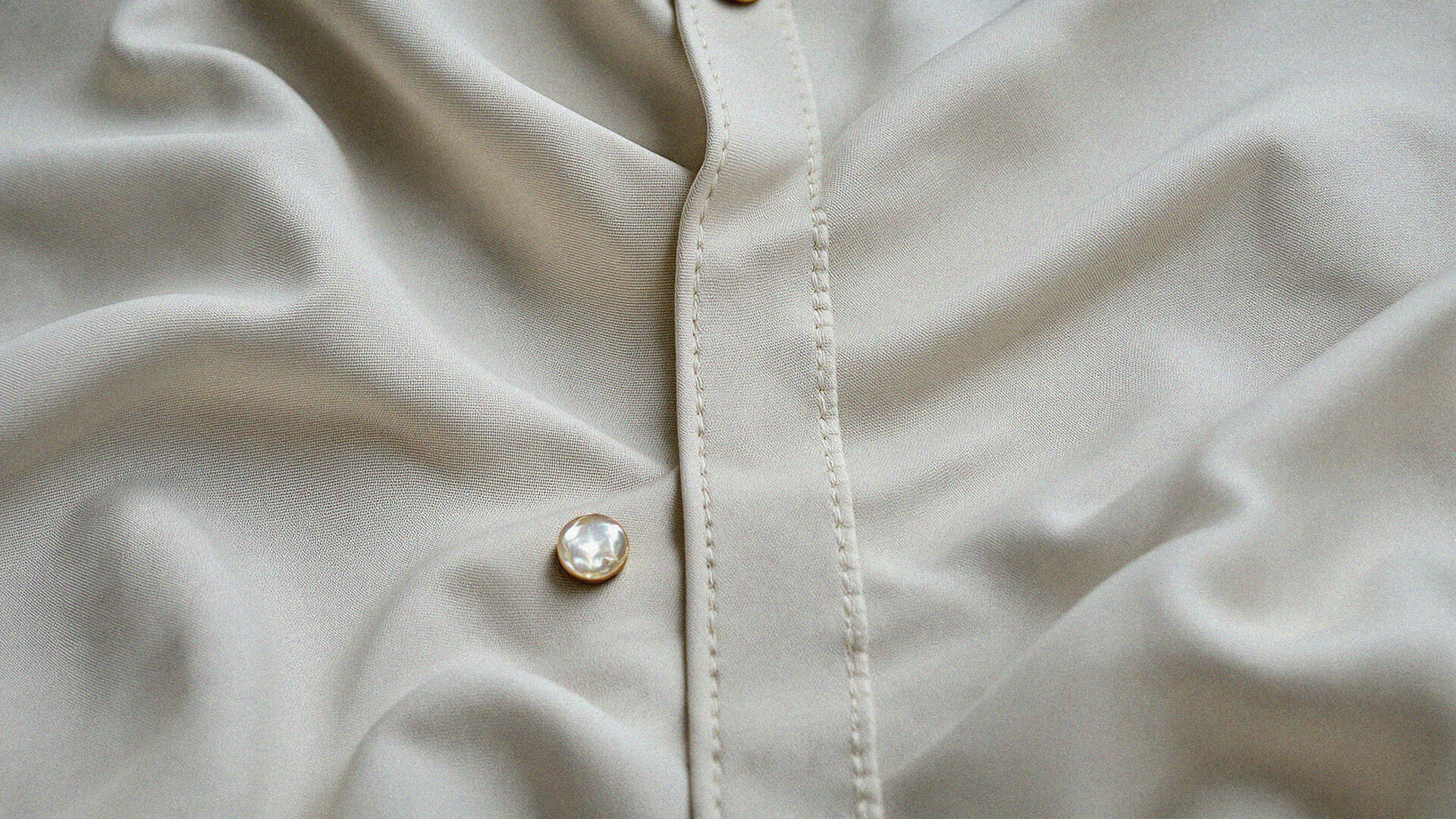
That small difference is the whole subject. One of those buttons is shell, and one is a replacement someone sewed on years ago and forgot about.
What mother-of-pearl actually is
Mother-of-pearl, or nacre, is the inner lining of certain mollusc shells: pearl oysters, abalone, freshwater mussels. The animal builds it in thin layers of calcium carbonate, held together by a protein. Light enters these layers, scatters, and comes back out at slightly different angles. This is why the colour seems to sit inside the surface rather than on it.
Plastic imitations work in a different way. Most are polyester resin with a pearlescent pigment mixed in, cast in sheets or moulds. The shine is real, and some of it is good. But it is a coating of light, not a depth of it. Once the eye learns that distinction, it is difficult to unsee.
How it looks
The play of colour
Real nacre is never one colour. Tilt a shell button slowly and the shine moves across it, often with pink, blue-grey, green or cream at the edges. The pattern tends to be irregular: a soft cloud in one corner, a faint ridge across the middle.
Plastic tends toward evenness. The sheen covers the whole face at the same intensity, and when the button tilts, the brightness changes but the colour mostly does not. Some resin buttons imitate the swirl of shell with marbled pigment. Even then, the swirl stays flat. It looks printed rather than layered.
No two alike
On a shirt with genuine shell buttons, a close look down the placket usually shows variation. One button is slightly creamier, another has a darker vein, a third catches more light. Makers sort shell for consistency, but they cannot make it identical.
Moulded buttons come out the same every time. Seven perfectly matched discs on a placket are not proof of plastic, but they are a reason to look more closely.
The back and the edge
The back of a shell button often tells more than the front. It can be duller, slightly greyish or brownish, sometimes with traces of the shell's outer layer. Plastic buttons are usually the same colour and finish on both sides.
The edge and the sewing holes are worth a look too. On nacre, the drilled holes and the rim sometimes show fine horizontal lines, which are the growth layers in cross-section. Plastic shows a clean, uniform wall. A tiny seam or a small raised dot on the back of a plastic button is a trace of the mould. Shell has neither.
How it feels
Temperature
Shell is mineral, so it feels cool against the skin at first and takes a moment to warm. Plastic reaches body temperature almost at once. Pressing a button against the inside of the wrist or the lip makes the difference clear quickly.
Weight
A shell button is denser than a resin button of the same size. The difference is small on one button but noticeable in a loose handful. On a heavy cardigan or a coat, the buttons have a slight pull that resin does not give.
The tooth test
Tailors and vintage dealers use an old check. They rub the button gently against the edge of a front tooth. Nacre feels faintly gritty, a little like fine sandpaper, because of its layered microstructure. Plastic feels smooth and slick. The same test works on pearls. It does not damage the shell, and it is often the most reliable answer when the eye cannot decide.
Shells that aren't nacre, and plastics that are good
Not every natural button is mother-of-pearl in the strict sense. Trochus shell, from a sea snail, is common on good shirts. It is whiter and more opaque, often with faint bands, and it shows less colour play. It still has the coolness, the weight and the grit. Abalone is the opposite: dark, almost electric blue-green, with an intense shimmer.
Plastic is not the villain here either. Good resin buttons are durable and inexpensive, and they survive industrial laundering better than shell. Many well-made garments use them for this reason. The aim of knowing the difference is not to sort the wardrobe into worthy and unworthy. The aim is to know what is in your hands.
Why it matters on the rail
Price is part of it, quietly. Shell buttons cost several times more than resin. On an expensive shirt, they are one of the few details that show where the money went. When a shirt sells at a premium and has plastic buttons, that is information. When an inexpensive vintage blouse has real shell, that is information too, and often a pleasant surprise.
Over years of wear, the arithmetic changes. A shirt with shell buttons can be worn for a decade, re-buttoned, passed on. The buttons tend to outlast the cotton around them. It is not a strong reason to buy anything. It is a mild reassurance about the things already in the closet.
The more lasting value is attention. People who look closely at one detail often start to see the rest of the garment differently: the stitch density at the collar, the weight of the fabric, the way a placket lies flat. When the wardrobe is photographed and laid out in Vitrina, these small details are easier to notice. A shirt is no longer just "the white one". It becomes the white one with the shell buttons and the slightly pink third button.
Living with shell
Nacre is calcium carbonate, so it reacts to a few things that plastic ignores. Acids dull it: vinegar, lemon, some stain removers. Strong heat can make it crack or lose its lustre, so people who iron shirts with shell buttons often work around them, or iron from the reverse side. A wash bag, a lower spin, and a cooler cycle are usually enough to keep the shine.
Over time, a shell button can develop a very faint chalkiness at the edge where thread and fingers wear it. This is not damage. It is a record of use, like the softening of a linen collar.
When a shell button cracks, the replacement is often the moment the difference becomes visible. A plastic button placed among six shell buttons looks almost right in a shop. At home, under a window, it looks like a stranger on the placket.
Most people own more mother-of-pearl than they think. It is on a grandparent's cardigan, a summer shirt bought on holiday, a blouse from a market stall. It rarely announces itself. It waits for someone to tilt it toward the light and notice that the colour is coming from somewhere inside.