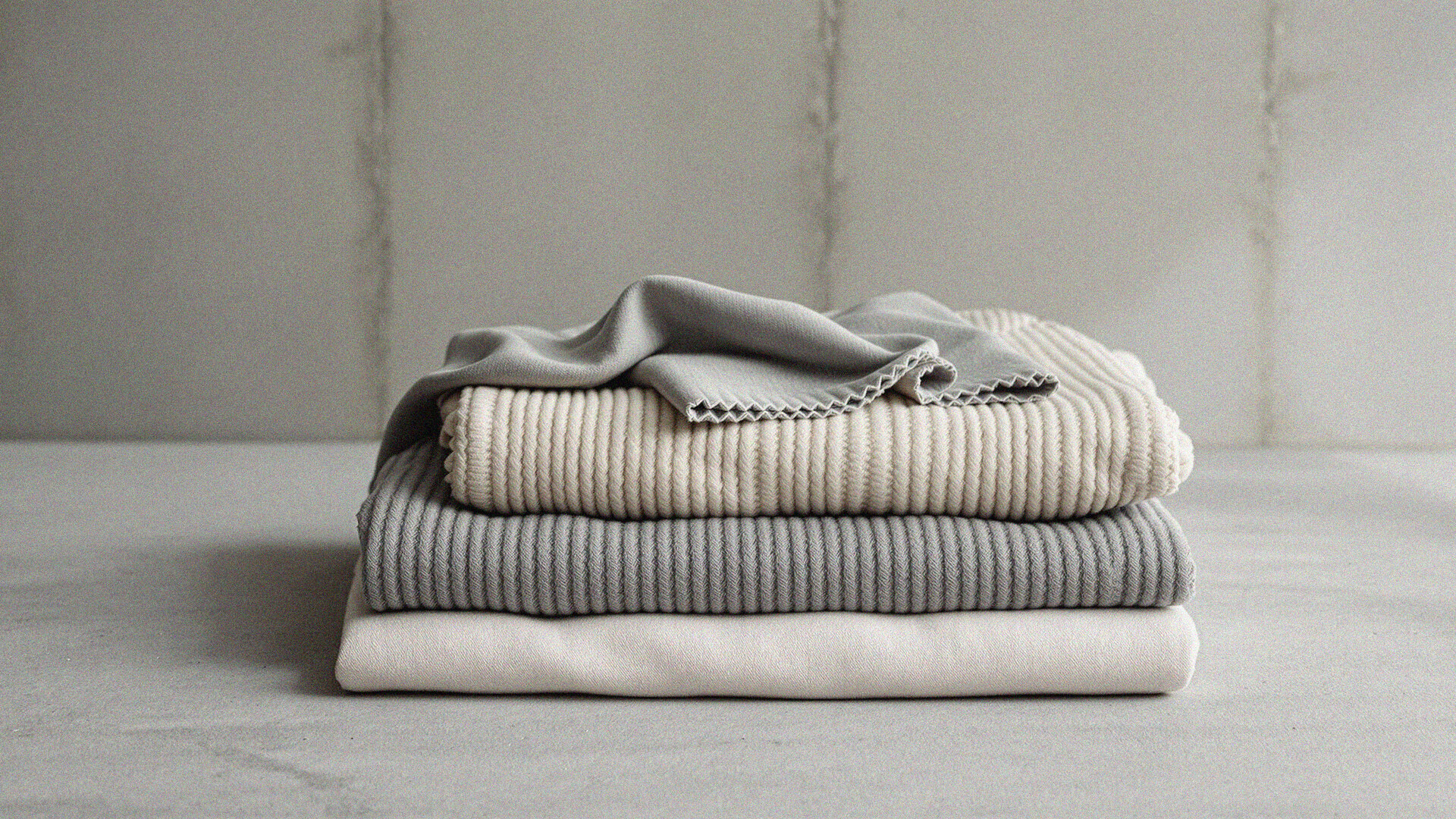
The word is gauge. Once it becomes visible, a stack of knitwear stops being a stack and starts being a set of distinct garments, each with a temperament.
What gauge actually measures
In factory knitwear, gauge refers to the number of needles per inch on the knitting machine. Labels and product descriptions shorten this to "gg." A 12gg sweater was knit on a machine with twelve needles to the inch. A 3gg sweater had three.
The relationship runs opposite to intuition: the higher the number, the finer the knit. More needles per inch mean smaller stitches, thinner yarn and a flatter, denser fabric. Fewer needles mean larger loops, heavier yarn and the raised, sculptural surface people call chunky.
Hand knitters use a related idea, counted as stitches across ten centimeters of finished fabric. The principle is the same. Gauge is a description of density, of how much yarn sits in a given square of cloth and how tightly it was asked to sit there.
The rough map
Knitwear tends to cluster into a few recognizable bands. The edges blur, but the centers are distinct.
- Superfine (16gg and above): close to a jersey in feel. Merino and silk-blend crewnecks, the kind that tuck into trousers without bulk. From a few feet away, the stitches disappear.
- Fine (12–14gg): the classic cashmere or merino layer. Thin enough for a shirt collar to sit on top, substantial enough to wear alone in spring.
- Mid-gauge (7–9gg): the everyday sweater. Stitches are visible but quiet. This is where most cotton crewnecks and lambswool pullovers live.
- Chunky (3–5gg): fisherman knits, shawl-collar cardigans, cable sweaters with real depth. These are outer layers more than inner ones.
- Ultra-chunky (below 3gg): the oversized, hand-feel pieces where each stitch is nearly the width of a finger.
Reading it without a label
Labels rarely mention gauge, and most people no longer have the tags anyway. The fabric itself carries the information.
Holding a knit up to a window tells a great deal. A fine gauge diffuses the light evenly, almost like paper. A chunky one breaks it into a lattice of bright gaps. Running a thumbnail across the surface helps too: on a fine knit the ridges are barely perceptible, while on a mid-gauge they register as a soft corduroy rhythm.
The most reliable method is the simplest. Counting the vertical columns of V-shaped stitches across one inch gives a number close to the machine gauge. Twelve columns suggest a 12gg knit. Five suggest something you would reach for in January.
Why the difference matters day to day
Gauge decides where a sweater belongs on the body and in the week. A 14gg merino works as a shirt. It sits close, layers under tailoring and moves between an office and a dinner without anyone registering it as a sweater at all. A 5gg cable knit works as a coat. It wants space beneath it and air around it, and it changes the silhouette of everything it touches.
People who have lived with knitwear for a while often notice that their favorite sweaters were favorites partly because of gauge. The one that always works under a jacket is fine. The one that feels like coming home is chunky. Neither reason was ever about color.
Warmth is not the same as thickness
A common assumption is that chunkier means warmer. Often it does, but not always. Large stitches trap air, and they also let wind through. A densely knit 12gg cashmere under a wool overcoat can hold more warmth than a loose 3gg acrylic on its own.
The fiber matters as much as the structure. A fine merino regulates temperature across a wide range. A chunky cotton is heavy without being particularly warm. Gauge describes the architecture, and the fiber describes the material it is built from.
Cost, quietly
Fine-gauge knits take longer to produce and use finer, more expensive yarn per gram. Their price often reflects that. They also tend to get worn more often, because they fit into more situations: under shirts, over T-shirts, alone, layered. Over a few years, the cost per wear of a good 12gg crewneck usually settles into something quite ordinary. A chunky cardigan works on a different rhythm. It gets fewer days, but they are the days people remember.
How each gauge ages
Fine knits show wear at the elbows and underarms first. Pilling appears early in short-staple fibers and then often settles once the loose ends have worked themselves free. A sweater stone or a gentle comb handles it. Small holes in fine gauge can be darned nearly invisibly, because the stitches are small enough to hide a repair.
Chunky knits rarely pill badly, but they stretch. Their own weight pulls them downward when they hang, which is why people who keep them for years tend to fold them flat on a shelf. A snagged loop on a 3gg sweater can usually be eased back into place with a blunt needle from the inside. The repair is visible if you look for it, and it tends to become part of the garment's character.
Washing follows the same logic. Fine knits tolerate a cool, careful hand wash and dry quickly when laid flat. Chunky knits hold water for a long time and need room and patience. They are often happier being aired between wears than washed.
Seeing the whole drawer
Most wardrobes lean heavily to one end of the scale without their owners realizing it. Some people own six mid-gauge crewnecks in slightly different blues and nothing fine enough to wear under a jacket. Others have a shelf of beautiful chunky cardigans and reach past them every morning for the same thin layer.
Laying everything out by gauge, finest to heaviest, tends to make the pattern obvious. Photographing each piece and tagging its weight in an app like Vitrina makes the same pattern visible on a phone. The gaps become clear, and so do the duplicates. So does the one sweater that does a job nothing else in the drawer can do.
That last one is worth noticing. It is usually the piece people would replace first if it were lost, and they rarely know why. Most often the answer is gauge.
The quiet knowledge
Over time, gauge stops being something people calculate and becomes something they feel. A hand reaches into the drawer and knows, by weight and texture alone, which sweater suits a gray Tuesday and which suits a cold Saturday walk. The decision happens before the thought does.
That is the real use of the knowledge. It is not a buying rule or a system. It is a finer sense of the things already folded on the shelf, of why each one exists and what it is for. A sweater you understand that well is one you no longer have to think about.