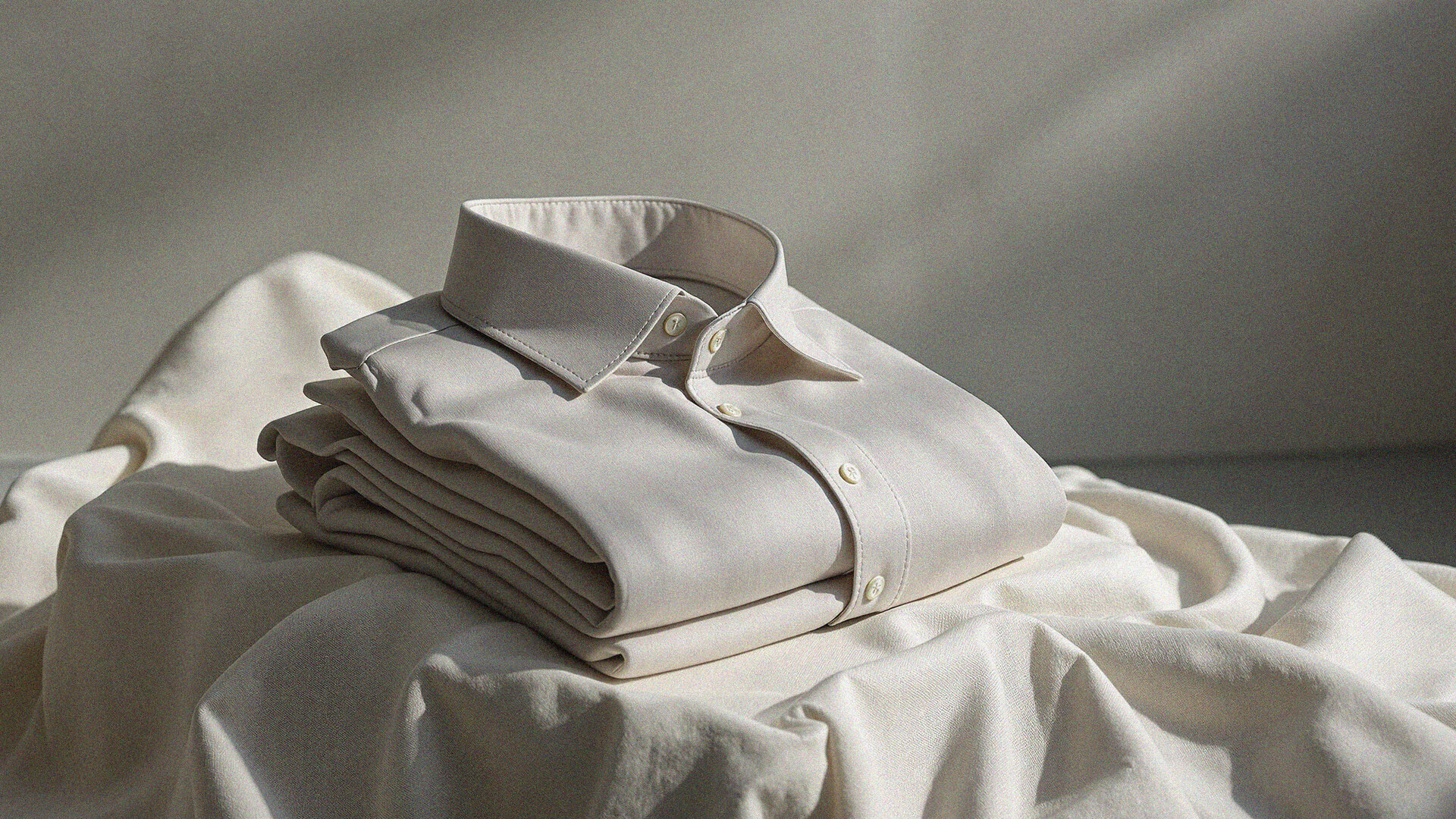
That something is mercerization, and once you know what to look for, you start noticing it everywhere in a closet.
What actually happens to the cotton
Raw cotton fibre, under magnification, is a flattened, twisted ribbon. It looks a bit like a collapsed drinking straw. Light hitting that surface scatters in every direction, which is why untreated cotton reads as matte and slightly dusty.
In 1844, a Lancashire calico printer named John Mercer found that soaking cotton in a strong solution of caustic soda changed the fibre permanently. The ribbon swells, the twist relaxes, and the cross-section becomes rounder. Mercer was mostly interested in how much better the treated cloth took dye. He wasn't chasing shine.
The sheen came later. Around 1890, Horace Lowe worked out that if the cotton was held under tension while it was treated, the fibres stayed straight and smooth rather than shrinking back into a crinkle. A rounder, straighter fibre reflects light in a more orderly way. That orderly reflection is the glow you see on the second shirt.
So mercerization is two things at once: a chemical bath and a physical hold. The combination is what gives the fabric its particular character.
What changes, beyond the shine
The sheen is the visible part, but it isn't the most useful part. Cotton that has been through this process behaves differently in ways you feel long after you've stopped noticing the light.
- Colour goes deeper. The swollen fibre absorbs dye more readily. A navy polo in mercerized cotton is a darker, more saturated navy than the same dye on untreated yarn, and it holds that depth through many washes rather than drifting toward grey.
- The hand is cooler and drier. Smooth fibres slide against each other. The fabric feels crisp without being stiff, and it sits away from the skin a little rather than clinging.
- It's stronger. The treated fibre gains tensile strength, so the yarn can be spun finer for the same durability. This is why very light dress shirtings and fine-gauge knits are so often mercerized.
- It pills less. Loose fibre ends are what roll into pills. Mercerized yarns are usually made from longer-staple cotton and have fewer of those ends sticking out.
- It shrinks less. The process pre-shrinks the fibre, so a garment that has been mercerized tends to hold its shape across seasons.
Where it shows up in a closet
The classic home for mercerized cotton is the piqué polo. Lift a good one and look at the tiny raised cells of the knit under a lamp. Each one has a small highlight, and together they give the surface a quiet texture-with-light quality that an ordinary jersey polo lacks.
Fine poplin and broadcloth shirts are the other obvious place. A shirt described as "silky" or "two-fold" or "Sea Island" has almost certainly been mercerized, whether or not the label says so. The glow is subtle in white, more obvious in pale blue, and unmistakable in black, where untreated cotton always looks a little tired.
It appears in less expected places too. Fine-gauge knitted cotton sweaters, the kind that drape rather than sit boxy. Dress socks that feel smoother than the rest of the drawer. Some T-shirts, though the description "mercerized" on a tee is often more marketing than process.
People who go through their wardrobe with this in mind usually find they already own several pieces. They just never had a name for why those pieces felt different. Seeing the whole closet at once, the way Vitrina lays it out, tends to bring the same quiet recognition: the shirts that get reached for most often share this finish, and the recognition arrives with a name attached.
What it's like to live with
A mercerized shirt asks for very little. It comes out of the wash with fewer creases than plain cotton, and it takes an iron well because the smooth fibre lets the plate glide. Cool water and a normal cycle are enough. Hot dryers are the one thing that dulls the surface over time, not because the fibre is fragile, but because tumbling roughs up any smooth finish eventually.
The colour stays. This is the part people notice most after a year or two. A mercerized navy polo washed forty times still looks like navy. The untreated one next to it has quietly become something closer to slate.
The sheen also softens with age rather than disappearing. A well-worn mercerized shirt has a low, even glow, more like polished wood than a new car. It's a good way to age.
Reading a label
Not every brand states it. When they do, the words are usually "mercerized", "mercerised", "silky cotton", "long-staple", or a proprietary name. When they don't, the fabric tells you anyway. Hold it in daylight and turn it slowly. Matte cotton stays matte from every angle. Mercerized cotton shifts, catching light on the ridges of the weave or knit and releasing it in the hollows.
It is not a mark of expense. Plenty of mid-priced polos are mercerized, and plenty of expensive tees are not. It's a mark of a particular decision made at the mill, one that changes how the garment behaves for its whole life.
The quiet step
Mercer's discovery has been in continuous use for nearly two centuries, which is a long time for a textile process to survive unchanged. It survives because it does something small and permanent. The cotton isn't disguised or coated. It's opened up a little, straightened, and left to be more fully what it already was.
That's a good description of what happens when someone starts to know their own clothes. Nothing is added. The two white shirts on the chair were always different. Seeing why is the whole change.