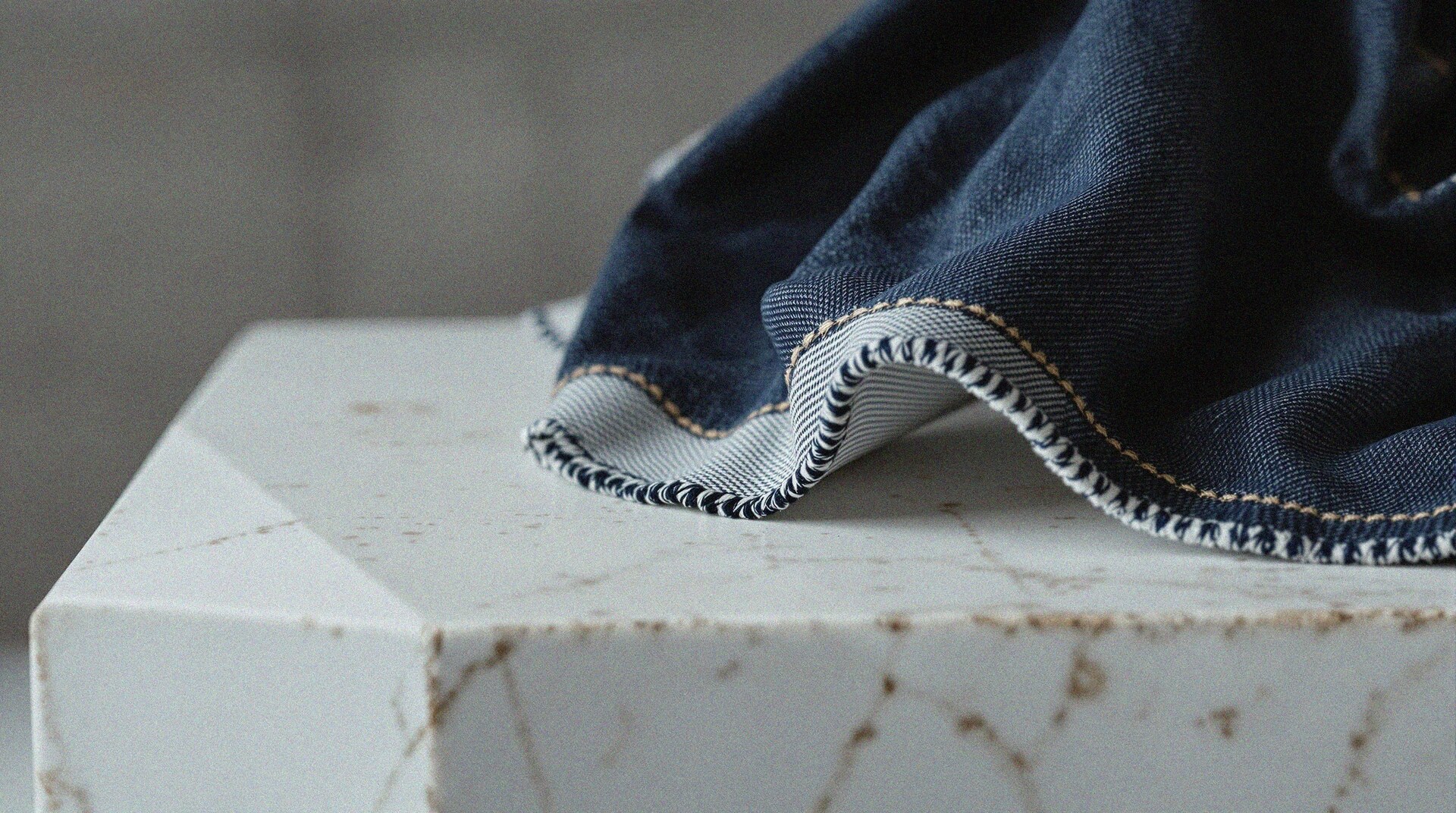
The Secret Life of Blue
When you pull on your favorite pair of jeans, you aren’t just wearing a garment; you are wearing a complex piece of textile engineering. Most of us choose denim based on the wash, but the way those blues settle into the fibers determines how the piece will look three years from now.
In the world of curated wardrobes, understanding the dyeing process is the key to longevity. It allows you to predict whether a garment will maintain its crisp, dark indigo or evolve into a lived-in masterpiece with high-contrast fades.
At Vitrina, we often see users cataloging denim that has lost its luster after just a few washes. Often, the culprit isn't the laundry cycle, but a fundamental misunderstanding of how the fabric was colored in the first place.
The Gold Standard: Indigo Rope-Dyeing
If you own a pair of high-quality raw denim or premium vintage-style jeans, they were likely created using indigo rope-dyeing. This is widely considered the best method for coloring denim yarns because it treats the thread with incredible precision.
In this process, long strands of cotton yarn are twisted into a "rope." These ropes travel through a series of indigo vats on a massive machine, dipping in and out of the dye. When the yarn emerges from the vat, it looks green; it only turns that classic blue once it hits the air and undergoes oxidation.
The Ring-Dyeing Effect
The most critical aspect of rope-dyeing is that the indigo never fully penetrates the center of the yarn. This creates a phenomenon known as ring-dyeing, where the outer layers are deep blue, but the core remains stark white.
This white core is exactly why your jeans fade at the knees and pocket edges. As you move, the blue surface layer of the yarn rubs off, slowly revealing the white center underneath. This creates the high-contrast "whiskers" and "honeycombs" that denim enthusiasts prize.
The Uniform Alternative: Piece-Dyeing
Not every blue garment is designed to fade. When you find a pair of navy trousers or a denim-look shirt that stays perfectly dark after twenty washes, you are likely looking at piece-dyeing.
In this method, the fabric is woven first using undyed (greige) yarns. The entire "piece" of finished cloth is then submerged in a dye bath, ensuring that the color saturates every single fiber from the surface to the core.
Why Piece-Dyeing Matters
Piece-dyeing is excellent for women who prefer a polished, minimalist aesthetic. If your capsule wardrobe relies on a sophisticated, dark navy palette, piece-dyed fabrics will provide the color consistency you need.
Unlike rope-dyed yarns, these fibers do not have a white core. When the surface wears down, it simply reveals more blue underneath. This results in a much slower, more uniform loss of color rather than the rugged character of traditional denim.
Why Your Jeans Fade: The Science of Wear
Fading is essentially a record of your physical movements. Every time you sit, walk, or place your phone in your pocket, you are applying abrasion to the indigo molecules sitting on the surface of the yarn.
Because indigo is a "substantive" dye, it doesn't chemically bond to the cotton in the same way other dyes do. It sits on the outside like a coat of paint. In rope-dyed denim, this creates a beautiful evolution of color that reflects your lifestyle.
Sustainable fashion is often about buying less and wearing longer. By choosing jeans with a white yarn core, you are investing in a garment that actually improves with age, reducing the urge to replace it when it starts to look "used."
Choosing the Right Denim for Your Wardrobe
When adding new pieces to your digital closet in Vitrina, pay attention to the fabric description. Look for terms like "ring-spun" or "rope-dyed" if you want that classic, evolving denim look.
If you are performing a color analysis and find that you look best in deep, saturated tones, look for "sulfur-dyed" or "reactive-dyed" blacks and blues. These methods offer much higher colorfastness, ensuring your darks stay dark.
Sustainability isn't just about the material; it is about the chemistry. Modern mills are now using pre-reduced indigo, which requires fewer chemicals and less water than traditional methods, making it easier to build an ethical wardrobe.
Maintaining the Indigo
If you want to preserve the deep indigo of a rope-dyed garment for as long as possible, the rule is simple: wash cold and wash less. Heat and agitation are the enemies of the indigo bond.
Turning your jeans inside out before washing protects the surface fibers from rubbing against the machine drum. This prevents "streaky" fading and keeps the abrasion focused on the areas where your body naturally creates friction.
Using a digital wardrobe tool like Vitrina can help you track how many wears you get between washes. This data-driven approach to garment care ensures you aren't over-cleaning your clothes, which extends their lifespan and saves water.
The Beauty of Imperfection
In a world of fast-fashion and synthetic dyes, indigo remains a living color. It changes, lightens, and conforms to the person wearing it. It is perhaps the only fabric that tells a story about the person who owns it.
Understanding the difference between piece-dye and rope-dye helps you become a more intentional consumer. You stop buying for the trend and start buying for the way the fabric will behave over time.
Whether you prefer the pristine look of fully saturated fibers or the rugged charm of a high-contrast fade, knowing the "how" behind the blue makes every outfit feel a little more personal.