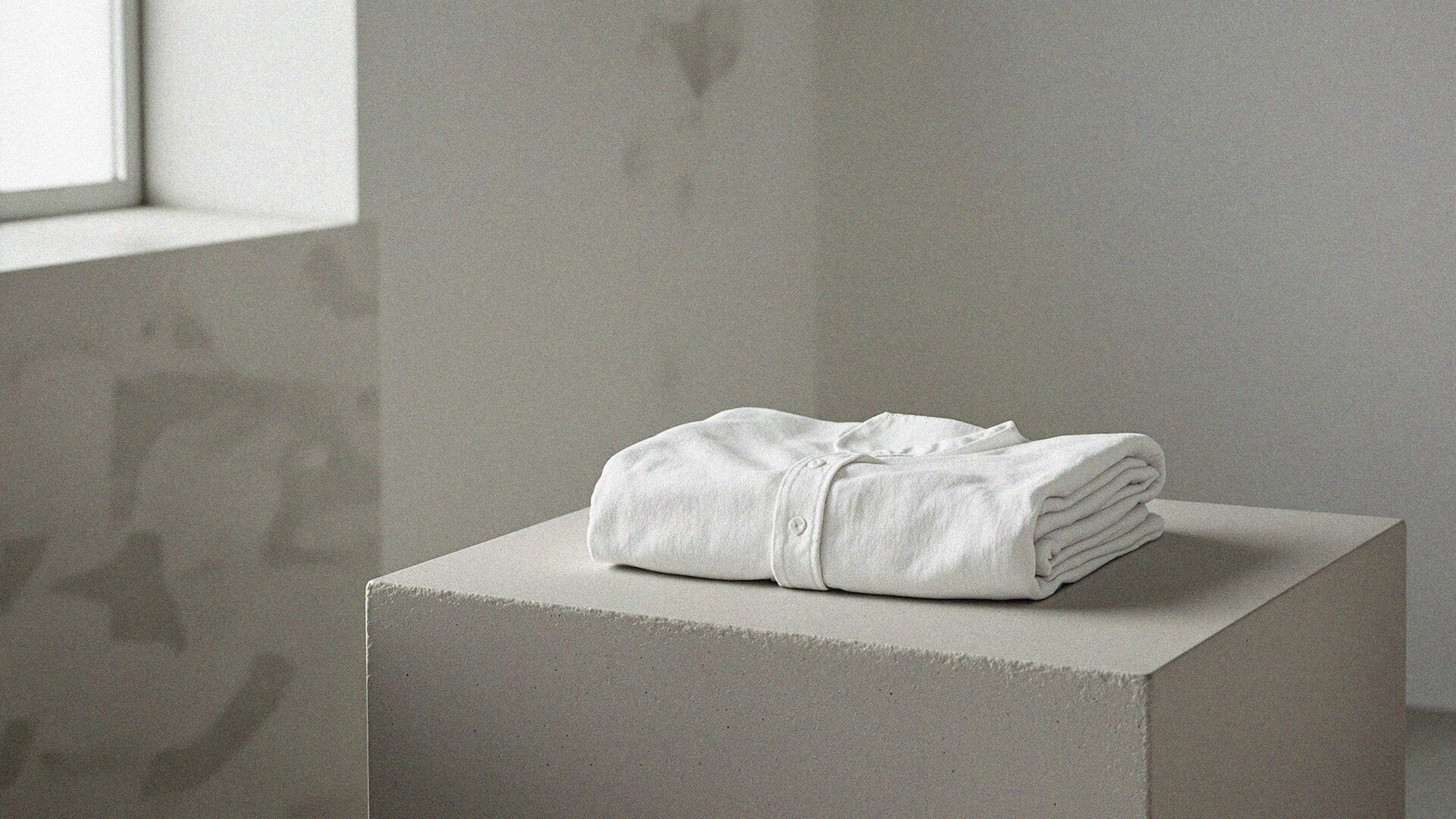
Most wardrobe photos are made for someone else — a buyer, a friend, a feed. A photo you'll actually use is made for yourself, months from now, half-awake, deciding what to wear. That's a different picture, and it turns out to be easier to take than the flattering kind.
The point isn't a beautiful photo
A catalog photo has one job: to let you recognize the garment instantly, without opening the drawer.
Which means the picture carries the true color, the real texture, and the details that distinguish this white shirt from the two other white shirts. A gorgeous, moody shot with the collar in shadow fails at this. A plain, evenly lit, slightly boring shot succeeds.
Once people stop trying to make clothes look good and start trying to make them look accurate, the whole thing gets quicker. There's no styling in it. It's closer to recording.
Light is the only equipment that matters
Everything else — the camera, the background, the app — sits well behind the question of where the light comes from.
Daylight, indirect. A window on an overcast day, or a window with the direct sun falling somewhere else in the room, gives the flattest, truest rendering of color you can get without a studio. Direct sun creates hard shadows and blows out pale fabric. North-facing windows tend to be the quiet favorite of people who photograph a lot of things.
Overhead room light is the usual culprit. Warm bulbs turn a cool grey into a muddy taupe, and your future self pulls the sweater out expecting one color and finds another. People shooting at night often land on a single lamp with a daylight-balanced bulb, aimed at a white wall to bounce — it reads truer than the ceiling fixture.
One light source, not three. Mixed light — window plus lamp plus phone flash — layers competing color casts that no automatic white balance untangles. When the other lights are off and the window does the work, the color comes back honest.
The setup, once, so the deciding stops
The reason wardrobe catalogs go unfinished is that every photo becomes a small negotiation about where to stand. Once the negotiation is gone, the whole closet gets shot in an afternoon.
People who get through it tend to pick one spot near their best window and leave it set up:
- A flat surface or a clean wall. The floor by the window works. So does a sheet pinned behind a door. Consistency matters more than the surface being pretty.
- A neutral background. White, grey, or a very plain wood. A busy rug makes the app — and your eye — struggle to find the garment's edges. Loud backgrounds also throw off the camera's color reading.
- The same distance and height every time. Phone directly above for flat-lays, or straight-on for hanging pieces. When every photo is framed the same way, the catalog reads as one collection instead of a scrapbook.
Flat-lay or hanging — the garment decides
Neither method wins across the board. It depends on the piece.
Flat-lay — laid on the floor or a table, shot from directly above — suits knitwear, tees, folded trousers, anything that loses its shape on a hanger. The sleeves can be arranged, the full front shows, and the light stays even because nothing is casting shadows on itself.
Hanging or on a form suits structured pieces: a blazer, a coat, a shirt with a collar that means something. These want to be seen the way they fall on a body. A slim wooden hanger against a plain wall, shot straight-on at chest height, holds their shape honestly.
For the tricky ones — a pleated skirt, a dress with drape — a single photo on a hanger plus one detail shot of the fabric tells the whole story.
Details are what you'll actually search for
The wide shot proves you own the jacket. The close-up is what you'll recognize it by.
A second frame of the thing that makes the piece itself — the horn buttons, the herringbone weave, the small tear you keep meaning to mend, the exact green that reads differently in every light — holds what memory blurs. A photograph keeps it still.
This is also where a wardrobe catalog earns its keep. A tool like Vitrina, which lays your whole closet out as images you can actually look at, only works as well as the photos you feed it. Accurate frames give you an honest inventory. Flattering ones give you a mood board you stop opening.
Consistency beats quality
A hundred plain, consistent photos are worth more than a dozen beautiful ones and eighty blanks.
The failure mode is always the same: the first ten garments get a lovely, careful shot, the enthusiasm fades, and the rest of the closet stays invisible. A catalog with holes in it is a catalog you don't trust, and one you don't trust, you stop opening.
That's why the standard stays low on purpose. Same window, same distance, folds smoothed, one frame wide and one detail if the piece deserves it — enough to get through the whole rail. The six pieces that matter most can always be reshot later, once everything else is at least on record.
What a full catalog gives back
There's a particular calm in opening a closet you've already seen. You know the grey trousers are there before you look. You remember the second white shirt exists — the one with the better collar — instead of reaching for the same one out of habit.
Photographing your clothes well isn't about turning your wardrobe into a shop. It's about being able to see, in one glance, everything you already chose to own. The morning gets quieter when nothing in the closet can surprise you, and the sweater you photographed properly is the one you finally start to wear.