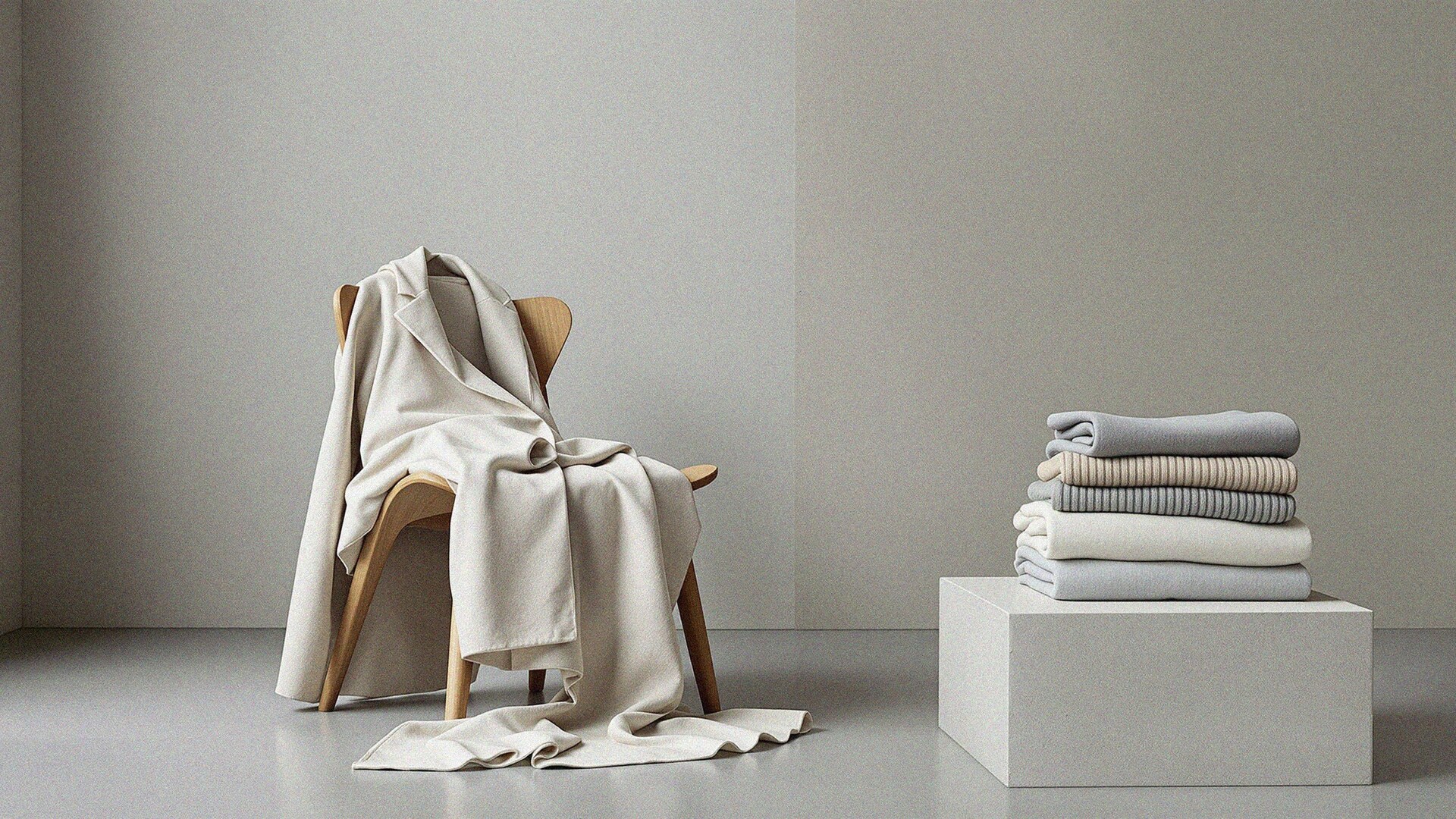
This is not a character flaw. It's how attention works. The eye stops registering what it sees every day — the hallway picture frame, the kitchen tile, the second shelf of the wardrobe. And so a person can own a hundred and twenty things and live, in practice, out of fifteen.
The closet becomes one object
After enough mornings, a wardrobe stops being a collection of individual garments and becomes a single block — the closet — that the hand navigates on autopilot. The same three hangers, the same drawer, the same folded stack on the left.
What sits outside that flight path doesn't get rejected. Rejection would at least be a decision. It just goes unregistered, the way a word repeated too many times stops sounding like a word.
The first honest step toward noticing what you own is admitting that you currently don't. Not because you're careless — because familiarity is a kind of blindness, and everyone's closet earns it eventually.
Taking things out, one at a time
People who know their wardrobes well tend to have done some version of the same thing at some point: they took everything out and held each piece individually.
Not to sort into keep-donate-toss piles. Not as a weekend project with trash bags. Just to look — at one shirt, in daylight, away from its neighbors. A garment on a crowded rail is information compressed beyond reading. The same garment laid on a bed is suddenly legible: the actual color, the weight of the fabric, the small repair at the cuff you forgot was there.
Something happens in the hands during this. Touch is memory's fastest route. A wool jumper held for ten seconds brings back the winter it was bought, the person who said it suited you, the reason it migrated to the back. None of that surfaces while it hangs compressed between two coats.
The middle layer
Every wardrobe has three populations. The loved things, worn weekly, no attention needed. The clearly wrong things — wrong size, wrong life — which announce themselves. And then the middle layer: the largest group and the quietest one.
The middle layer is where the unworn-but-fine things live. The shirt that's good but never first choice. The trousers that need one specific shoe you rarely wear. The dress that belongs to a slightly different version of your week.
These pieces aren't failures. Most of them were reasonable purchases that simply never got introduced to the rest of the closet. When people go through the middle layer slowly, they tend to find that maybe a third of it comes back to life from nothing more than being seen again — placed next to a different jacket, moved to eye level, tried with the things bought three years later.
A record changes what the eye does
There's a particular shift that happens when a wardrobe exists somewhere outside the wardrobe — photographed, listed, visible as a whole. Not as inventory for its own sake, but because the eye treats a picture of a shirt differently than the shirt itself. The picture hasn't been seen four hundred times. It's still legible.
This is roughly what Vitrina is for: not managing clothes, but holding up the whole closet at a distance where it turns back into individual things. People who keep some form of record — an app, photos, even a written list — describe the same effect. They start recognizing their own clothes again, the way you recognize your street in someone else's photograph.
The numbers, if anyone wants them, are quietly reassuring rather than dramatic. A coat worn eighty times has done more than three coats worn ten times each, whatever any of them cost. But that arithmetic is a side effect of attention, not the reason for it. Nobody falls back in love with a coat because of a spreadsheet.
Knowing a garment is mostly care
There's a difference between owning a linen shirt and knowing one. Knowing it means knowing it wrinkles in a way that looks better by afternoon. That it softens noticeably after the tenth wash. That it dries fast enough to be washed the night before.
This kind of knowledge only accumulates through care — the washing, the hanging, the occasional mending. Not as maintenance discipline, but the way you come to know anything: by handling it repeatedly with some attention.
People who've lived this way for a few years tend to describe their relationship with specific garments the way others describe tools or instruments. The boots that took a season to break in. The jacket whose lining was replaced once and now feels more theirs than when it was new. A repaired thing is a known thing; the repair is proof someone was paying attention.
What gets noticed when you're looking
- The pieces that work in every season turn out to be fewer and plainer than expected.
- The colors actually worn are narrower than the colors owned — and the worn ones are the answer to most future questions.
- The garments that feel best almost always share a fabric, not a brand.
- The gaps in a wardrobe are smaller and more specific than the vague feeling of "nothing to wear" suggested.
What the looking makes possible
The endpoint of noticing what you own isn't a tidier closet, though that tends to happen. It's a quieter morning. The reach toward the rail stops being a negotiation and becomes something closer to greeting — these are known things, chosen once with some care and re-chosen since, many times, with more.
A person who knows their wardrobe walks into a shop differently, too. Not armored with rules about buying less, just genuinely harder to convince — the way someone who has eaten well is hard to tempt with anything.
But mostly it shows up at home, on an ordinary Tuesday, in the small unremarkable fact of getting dressed without searching. The clothes were always there. The attention is what arrived.